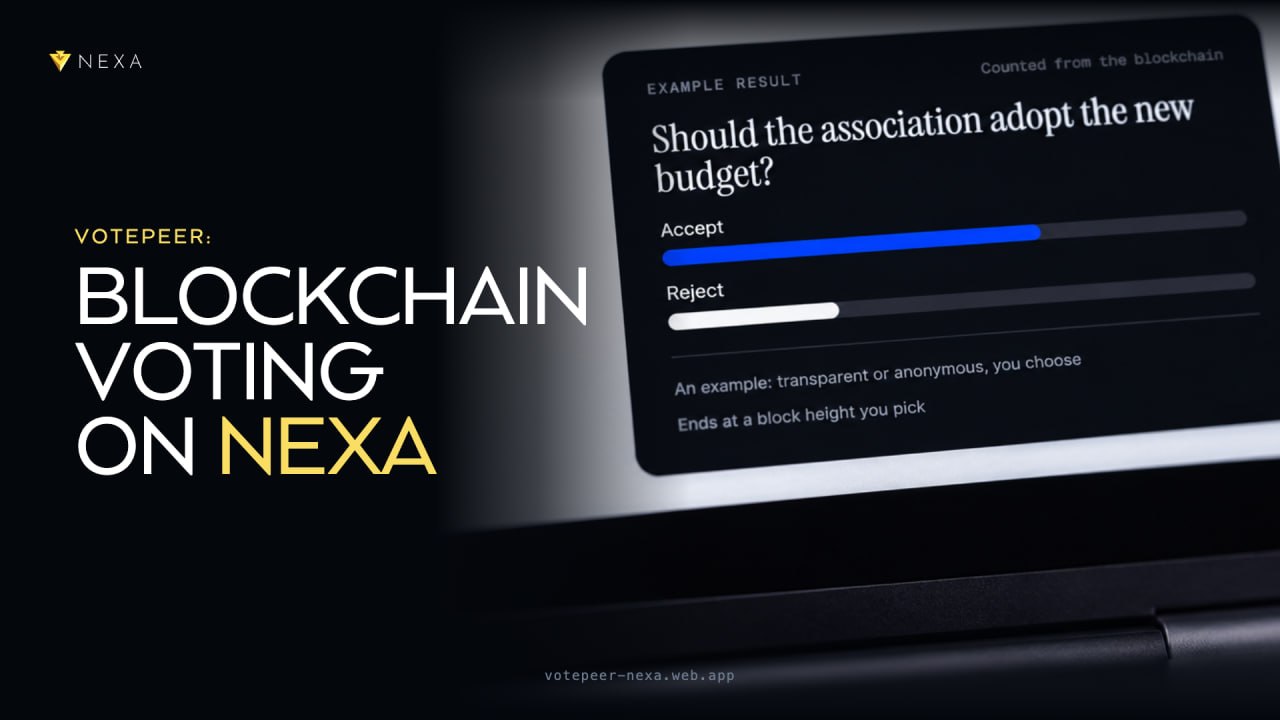
It’s exciting to introduce you to VotePeer – an open and fair voting system on the Nexa blockchain. VotePeer hosts elections on-chain in a trustless environment where every vote requires a digital signature and is recorded on the public ledger. This keeps voting fair and open, and anyone can audit it.
VotePeer is an open-source decentralized application where every ballot is a Nexa transaction recorded on the blockchain. It lets associations, boards, and communities organize voting and hold elections.
Sponsored and developed by Bitcoin Unlimited as part of BUIP129, VotePeer is now available in the Nexa Android App on the Google Play Store. iOS is waiting for App Store review and will go live soon. To join the VotePeer beta, open the link on your iPhone, iPad, or Mac after you install TestFlight.
-
Website: https://votepeer-nexa.web.app
-
Google Play App: https://play.google.com/store/apps/details?id=org.nexa.voting
-
iPhone and Mac on TestFlight: https://testflight.apple.com/join/4XFRXj48
How an Election Runs
Anyone can organize and set up an election in a few clicks on the VotePeer website; it’s a place where you set things up, and everyone can see the results. An organizer can set up an election and invite voters to participate by their Nexa ID.
Voting can happen anonymously or in a disclosed manner; an organizer can also add participants by pasting or scanning their Nexa IDs. Voting happens in the VotePeer application, and each vote costs a small transaction fee.
People without NEXA can claim it from the faucet, and after voting, anyone can read the results. All the results are counted from the blockchain, and votes are accepted once they’re recorded in a block.
Three Kinds of Elections
So far, there are three types of VotePeer smart contracts and three kinds of elections, but open elections use two contracts.
Open elections: anyone can vote, and all votes are public, and an open election has no participant list. Anyone with a Nexa ID can vote while it runs, and anyone with the link can see the election and its result without logging in. It is also listed under Public elections.
Transparent elections: only invited Nexa IDs can vote; the votes are public, and each vote is recorded on the Nexa blockchain. Good for boards and members who answer to each other. Everyone can see on the blockchain how each participant voted.
Anonymous elections: only invited Nexa IDs can vote, and the votes are anonymous. Your ballot carries a ring signature that proves the vote comes from one of the participants without revealing which one, and it prevents double voting. Nobody can see how you voted, only that someone in the group voted, but the count stays verifiable.
All of them are Pay-to-Template (P2T) contracts written in NPL. The contracts that carry ballots on the Nexa blockchain are: MultiOptionVote for transparent elections, PayloadContract for anonymous ring-signature ballots, and OpenMultiOptionVote with its ElectionBeacon for open elections anyone can vote in.
Your Nexa ID
The application creates your identity and a Nexa key on your phone. There is no username like in traditional accounts, no password or email address. Instead, we use Nexa ID to log in. Your Nexa ID appears as text and as a QR code to give to election organizers, along with the balance that pays for your votes, and your 12-word recovery phrase is encrypted on your phone with a key that requires your fingerprint, face, or screen lock. You can always restore an identity from its recovery phrase.
Sign in to votepeer-nexa.web.app: press Login on the website and scan its QR code with the app. You log in with your Nexa ID from the application.
Create an Election and Pay for a Vote
Anyone can create an election in four steps: set up the question and options, add participants, and, when voting closes, review the results. You can choose transparent or anonymous, add participants by scanning their Nexa ID QR code, pasting or typing it, or adding a whole voter group. Keep voter groups, such as a board or a club, to add to the next election, and share the election’s link once it is created.
A vote takes a small Nexa transaction, paid in NEX from your Nexa ID, and the app shows the cost before you send it. The VotePeer app also lets you refill 1000 NEX from the VotePeer faucet if you don’t have NEX for fees. If you’re new, the faucet sends enough to your Nexa ID, the address you log in with, for your first votes in the VotePeer app.
VotePeer faucet: https://votepeer-nexa.web.app/#/faucet
In Conclusion
VotePeer leverages the strengths of the blockchain and provides a real-world use case to conduct open, transparent, and fair elections. Whether it is a group of friends, associations, or official organizations, it’s a deterministic and provable way to host elections.
VotePeer is decentralized, free to use, and open source (MIT), with no ads or tracking, and is developed by Bitcoin Unlimited developers and powered by Nexa. For this application, we are grateful to B.U. developer Jørgen Notland.
VotePeer on X: https://x.com/votepeer
VotePeer Telegram Group: https://t.me/buip129