
This August is exciting and brings us a lot of positive news. The president of Bitcoin Unlimited, Andrew Clifford, has explained the new 2.0 version of the NexaPoW algorithm, a fundamental improvement to the Nexa blockchain. The new algorithm is an indirectly useful proof-of-work which is changing how we look at proof-of-work itself. For many years, old-fashioned PoW was considered just e-waste, which is not useful, but now it will directly correlate with the network’s capabilities.
Nexa Chief Scientist Dr Peter Rizun and Lead Developer Andrew Stone are working on NexaPoW from two different angles. Peter is implementing the new solution in the hardware, which will use an FPGA for mining and signature verification, removing the major bottleneck in full node operations.
Andrew is leading the efforts from the software side. In addition to hardware acceleration, the team is integrating the Tailstorm protocol into the main Nexa blockchain layer. Nexa is moving towards a directed acyclic graph (DAG) hybrid model combined with a traditional blockchain.
A hybrid model means that the Nexa blockchain will benefit from both model’s strengths. Preserving the traditional blockchain model and introducing what we will call summary-blocks, and combining them with sub-blocks that are created every few seconds, will make blocks faster to mine, ensure a fairer distribution of block rewards, and enable faster transaction verification.
To better understand all of this, B.U. president Andrew Clifford explained Nexa’s approach and the NexaPoW architecture. He discussed the history of how and when proof-of-work was invented, and how Nexa is moving towards indirectly useful PoW and aligning mining with signature verification algorithms so that all network users would benefit from improved mining.
Watch the full video below with Andrew Clifford rethinking PoW.
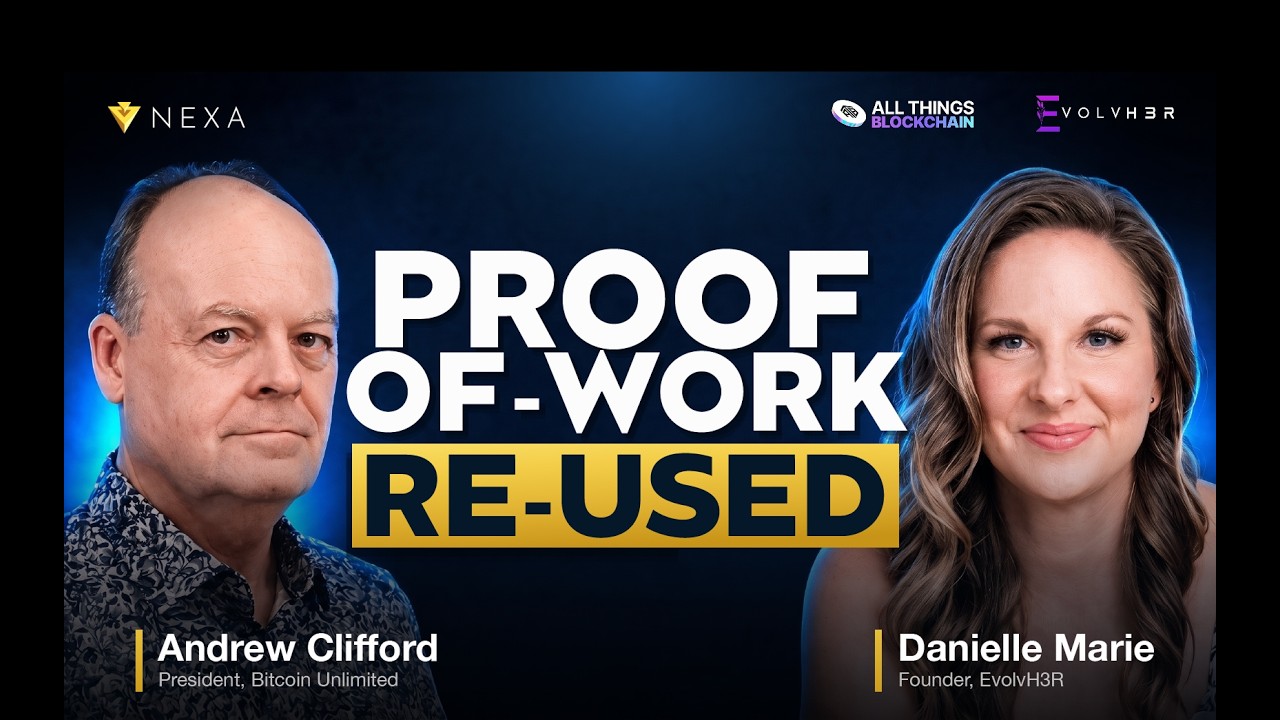
Rethinking Proof of Work: Understanding Nexa’s Architecture with Andrew Clifford
Bitcoin Unlimited President Andrew Clifford joined Danielle Marie of EvolveH3r for a webinar on proof-of-work, where it came from, and what Nexa has done to advance it. After Danielle’s introduction to the fundamentals of blockchain, layer one, UTXOs, decentralization, and the blockchain trilemma, Andrew took those concepts. He applied them to a functioning cryptocurrency, from the origins of proof-of-work in the early 1990s as an anti-spam mechanism to its role in Bitcoin mining and security, and on to NexaPoW and what users need to know about mining Nexa after its next algorithm upgrade. The full recording is below, and his presentation is recapped in text underneath it.
Read more:
A Node Made Of Wires
In the first article of this series, we explained why Nexa builds hardware. Proof-of-work spent seventeen years accelerating a computation that does nothing for the network’s capacity, and Nexa intends to point that same force at the work a money network actually needs. This article shows what that hardware actually is: a machine for validating money, built from the simplest electrical parts.
Nexa Chief Scientist, Dr Peter Rizun, is building a node as a circuit of digital logic gates. To see how a circuit can validate a money transaction with no software involved, you only need to meet six components.
Read more:
To Wrap Up
These days, a lot of attention is going to major Nexa developments as they are coming up together. Hardware acceleration with Blitz is one of the most significant, if not the most significant development, and is changing understanding of how blockchains can achieve scalability while preserving decentralization and security.
The Nexa team will maintain this direction over the coming weeks and months. On top of that, many ecosystem projects are advancing in parallel with the main layer advancements.
Follow us on the Nexa Forum, social media channels, and community groups to stay up to date and in the know.
Nexa Telegram: https://t.me/nexacoin
Nexa Discord: https://discord.com/invite/WJhWUEYSse