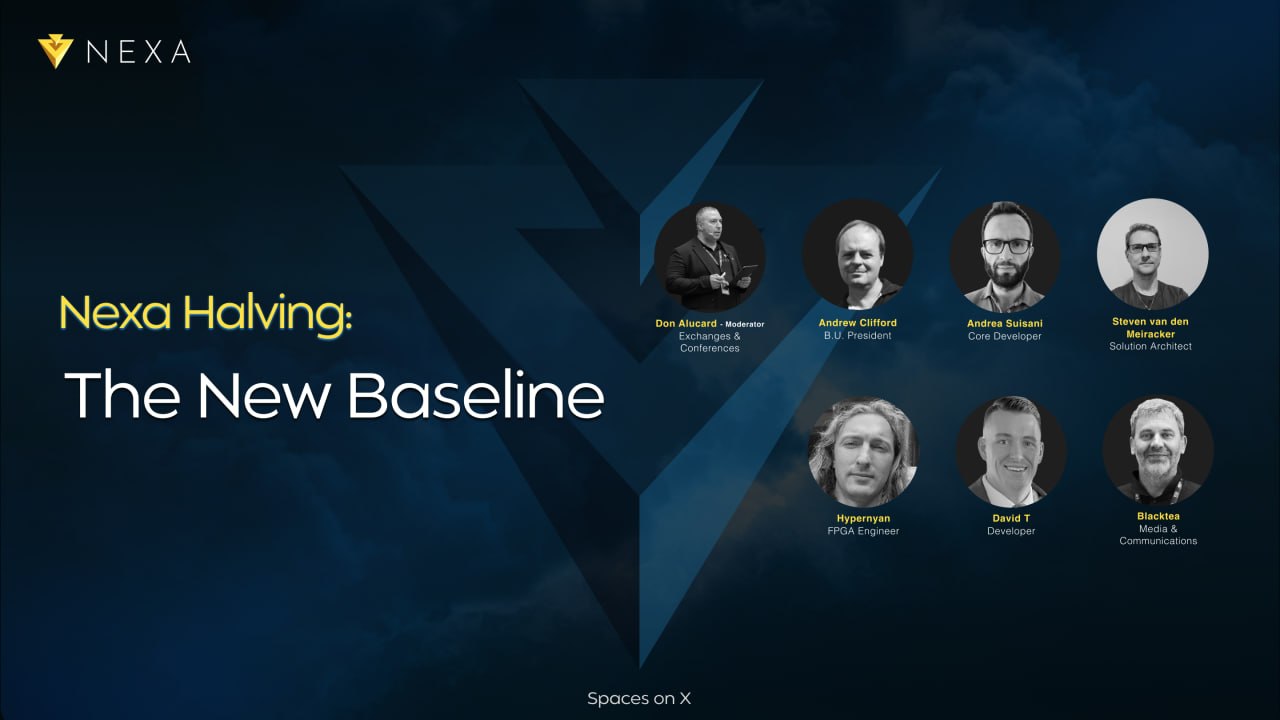
To mark the first Nexa halving, the team hosted Spaces on X on the very same day. The conversation was around looking back over four years and ahead to a year that may matter more than any since launch. Many important developments are on the way, including hardware acceleration with Blitz, improving fairness and moving towards a DAG-hybrid with Tailstorm, and providing insights into much-anticipated topics such as quantum resistance.
For those who prefer the text format, below is a short summary. For those who might have missed the event, here is the recording.
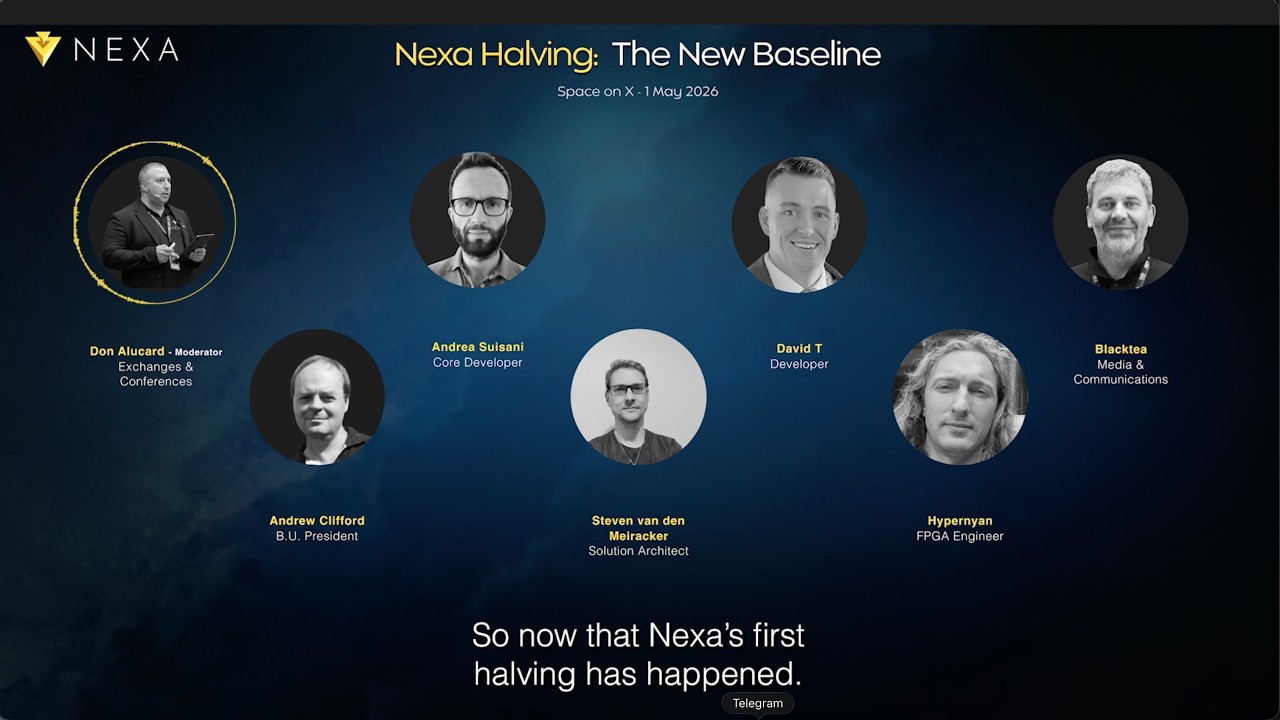
The First Milestone
Nexa launched in June 2022 with a handful of people, five or six, and now counts around twenty, and the sense throughout was of a project far stronger than it was at the start. The halving was always written into the schedule, set in stone since the Genesis block, yet watching it arrive live on mainnet was a turning point rather than a formality.
The first four years are the hardest for any coin on a four-year cycle, because roughly half of the total supply is being mined. Now that issuance is moving into its tail, far fewer new coins will be provided as mining rewards. What matters is its grip on an economy that mirrors Bitcoin’s rewards schedule, and with the first halving, Nexa has joined a few other proof-of-work coins following Bitcoin’s coin-tokenomics.
Four years have produced a battle-tested code base that survived a rough business, and putting consensus software into the wild is not an easy task. Nexa is an improved version of Bitcoin with a scripting language that supports loops, registers, introspection, and benchmarks of 60,000 transactions per second from ordinary home nodes around the world.
Undergoing Protocol Improvements
Hard fork is pushed back a few months for more rigorous testing, closing out most of the remaining base-layer work, with quantum-resistant addresses and UTXO commitments lined up for early next year. Its headline change is who gets to mine. The new algorithm favors CPUs first and gives GPUs only a modest edge, with FPGAs readily available for everybody as the intended ceiling. If ASICs ever threaten that balance, the mining seed can be rotated without a hard fork release to keep them out. The goal, stated plainly, is to put mining back within reach of everyone, as it was in Bitcoin’s early days, and, with it, to build a more decentralized network.
Much of the deeper work converges on three names. Tailstorm, a blend of the Bobtail and Storm protocols, smooths block-time variance and splits each reward among several miners instead of a single winner, while a chain of small sub-blocks between main blocks carries transactions forward and lends them more trust the moment they enter the mempool. The practical result is a chain solid enough for point-of-sale, where a merchant has no concern about the security of the transaction they’ve just accepted, and confirmations fine enough to read as 1.6 or 2.9 blocks rather than whole numbers.
Blitz is the hardware answer to scale: dedicated chips that let a node grow horizontally and deliver unlimited throughput while the CPU sits mostly idle, already delivering 10 times the power efficiency per operation. The quantum question is being addressed by adopting certified post-quantum signatures (Dilithium or Falcon), which are already integrated into Peter Tschipper’s private testnet and have been tested for a couple of years. Thanks to Tailstorm’s short mempool window, Nexa expects to be one of the last elliptic curve coins a quantum computer could touch, long after the exposed early Bitcoin addresses that stand as the canary in the coal mine.
Upcoming Tools and Applications
For all that protocol depth, the conversation kept circling back to things people can actually use. A trading card game, Nexa Warriors, stakes real on-chain cards inside a contract; win, and you take one from your opponent. A prediction and peer-to-peer betting app locks wagers in smart contracts and doubles as proof that you can use a contract for almost anything in Nexa. Behind both sits a push to make building easy: a single library bundling the compiler, the Kotlin DSL, and the Nexa scripting language; multi-platform apps written once for every device; and the Build On Nexa program, where, with AI in the loop, an idea can become a working app in a couple of days as opposed to a couple of months. Wrapped BTC is meant to bridge Nexa to the wider market as the first wrapped Bitcoin on a UTXO chain, and the framing was unambiguous: Nexa as what Bitcoin was supposed to be, with the throughput, smart contracts, and on-chain simplicity that make it a cleaner alternative to the Lightning Network.
Conclusion
The closing stretch belonged to the community, which named the project its number one priority, with an open invitation to share, comment, or simply run a node. A year from now, the hope is modest and concrete: a clean hard fork, a decentralized mining base, real applications running, maybe one going viral, and Nexa earning headlines outside the ecosystem.
Or, as the session signed off: the halving is not the endpoint. It is one milestone in a much bigger journey, and we are all on it.