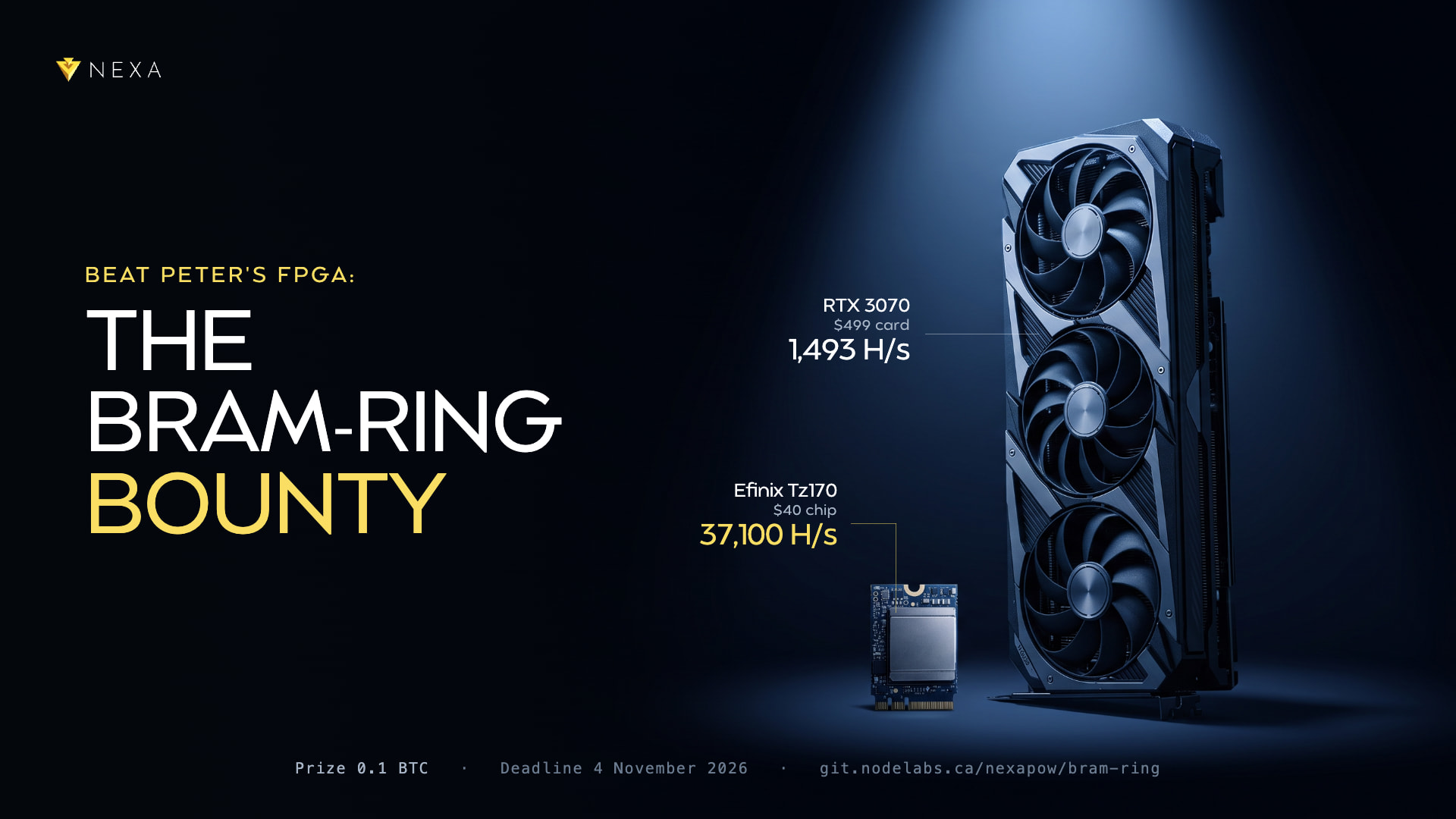
On 6 October 2026, Peter Rizun announced a bounty on X with a 0.2 BTC prize pool (around $16,000) for anyone who can beat the FPGA’s efficiency. The main prize is 0.1 BTC, with smaller prizes for smaller achievements, and the bounty is open until 4 November 2026, 23:59 Pacific Time.
Peter designed a BRAM-ring proof-of-work function on a cheap Efinix Tz170 FPGA and ran it at 37,100 H/s. So far, the best GPU result is 1,493 H/s on a $499 RTX 3070. Measured in hash rate per dollar of hardware, the FPGA is more than 100x more efficient. The claim is that no GPU, CPU, NPU or other off-the-shelf hardware can close the gap, and the bounty is for anyone who proves otherwise.
What BRAM-ring Is
BRAM-ring is a proof-of-work function designed to run fast on a cheap FPGA and slow on CPUs and GPUs. The name comes from BRAM, the block memory built into FPGA fabric. Each hash fills a working state, runs it through a ring of memory banks and cells, and finishes with a full SHA-256 digest.
The specification does 1,572,864 bank read-modify-writes and 31,457,280 cell evaluations per hash. An FPGA keeps all of that state in on-chip memory right next to the logic. A GPU or CPU has to move it through caches and external memory, and that is where it loses.
The function is frozen and defined by three files in the repository (spec.py, generate.py and vectors.txt), whose SHA-256 hashes are published in the rules. Lookup tables are regenerated from an epoch seed, so nothing can be hardwired to one set of constants.
The repository ships reference implementations in C, AVX2, CUDA and Verilog. A single make prove checks all of them against the same 8 test vectors.
The Numbers
Everything is judged by one number: mean hash rate per US dollar of hardware.
| Hardware | Hash rate | Price used | H/s per USD |
|---|---|---|---|
| Efinix Tz170 FPGA (one ring) | 37,100 H/s | $100 (defined) | 371 |
| Nvidia RTX 3070 | 1,493 H/s | $499 launch price | about 3 |
| Intel i7-12700KF (8 P-cores) | 822 H/s | not priced |
The FPGA figure is conservative on purpose, a Tz170 chip costs about $40 at small volume, but the bounty prices it at $100 to cover chip, board and retail margin. The 37,100 H/s rate is one ring at 95 MHz, the clock at which a 2-ring build on the larger Ti375 ran bit-exact on real silicon and measured 74,233 H/s. The Tz170 also closes timing at 201.8 MHz on the production speed grade, which would give about 78,700 H/s, roughly double the rate used for the target.
The target is 371 H/s per USD, and it stays fixed for the whole bounty.
Three Ways to Break It
Any of these counts, and all are judged by the same number.
-
Better hardware: Find a GPU, CPU, NPU or other commercially available non-FPGA device that reaches the target. For example, a card with more memory bandwidth per dollar, or enough on-die cache to hold a nonce’s state.
-
Better code: Make the CPU or GPU implementation fast enough to reach the target. The starting points are gpu/mine.py and cpu/verify_avx2.c. They have already survived several adversarial optimization passes, so the easy wins are gone.
-
A shortcut in the function: Find a weakness that computes correct outputs with much less work or memory than the specification implies. Degenerate address patterns, short cycles in the ring dynamics, weak lookup tables, a time-memory trade-off or a way around the fill would all qualify.
The Prizes
| Prize | What wins it |
|---|---|
| 0.1 BTC | The idea is broken: first claim showing non-FPGA hardware at or above 371 H/s per USD |
| 0.01 BTC | A bit-exact GPU kernel at least 10% faster than the current champion (1,493 H/s on the reference RTX 3070) |
| 0.01 BTC | A bit-exact CPU implementation at least 10% faster than the current champion (822 H/s on the reference i7-12700KF) |
| 0.01 BTC | A real shortcut: a bit-exact implementation doing at most half the work per hash, counted not timed |
The speed awards ratchet. Each verified winner becomes the new champion, and the next claim has to beat it by 10%. Speed and shortcut awards together are capped at 10 awards, which brings the full pool to 0.2 BTC.
Every claim must be bit-exact: your code has to reproduce all eight test vectors, accept the epoch seed as an input, and pass again on a fresh random seed Peter posts once your code is public. All speed measurements happen on Peter’s reference machine: five runs, arithmetic mean, with the champion measured back to back in the same session.
Negative results are welcome too. “I tried X, here is why it loses” earns no BTC, but it gets credited in the README.
How to Claim
Reply to Peter’s announcement on X with the full 40-character git commit hash of your code and the prize you are claiming, and the reply’s timestamp is your place in line.
Your code can stay private until the deadline, and the commit hash fixes your code exactly, so you can lock in priority without revealing your method. Before the deadline, publish the commit on any public git host with everything needed to reproduce the result: code, build instructions, a benchmark entry point and an open-source licence. A 0.1 BTC claim also needs retail price evidence for the hardware, your five-run log and one mined nonce.
Posting early matters: sealed claims can set a higher bar you cannot see yet, so the published figures are a floor.
Deadline: 4 November 2026, 23:59 Pacific Time. Winners are settled after the deadline, once every claim is verified, and no later than 60 days after it.
Proof of Funds
The 0.2 BTC prize pool sits at this address, with 0.20093990 BTC confirmed in block 970089:
bc1qtk8q5nsupm47kg5vz9turqacx8lg2whvxukpuj
Message signed by that address:
Peter Rizun holds the 0.2 BTC prize pool for the NEXA BRAM-ring bounty at this address. Rules: BOUNTY.md · main · nexapow / bram-ring · GitLab 2026-10-05
Signature:
HxALKo2u0bmkpOxC6Xdvb26yeMs/eT/flSNVaIFzLC9FL0GY4/oUkw+OJXS5sXVIRP9gER4LKmYl3ymHT21LrsY=
Anyone can check it with the “verify message” function in Electrum or Sparrow.
Why It Matters for Nexa
BRAM-ring is part of the nexapow project, and the bounty is signed as the NEXA BRAM-ring bounty. The goal is a proof-of-work where a cheap, widely available FPGA is the most cost-effective way to mine, rather than whoever owns the biggest GPU farm.
This bounty is how that claim gets tested. Peter has published the code, frozen the function and put real BTC behind it. To date, the original post has more than 222,200 views, but no one has claimed the bounty yet.
Sources
-
Peter Rizun’s announcement on X https://x.com/PeterRizun/status/2107245548311060888
-
Bounty rules (BOUNTY.md) https://git.nodelabs.ca/nexapow/bram-ring/-/blob/main/BOUNTY.md
-
BRAM-ring code repository https://git.nodelabs.ca/nexapow/bram-ring