
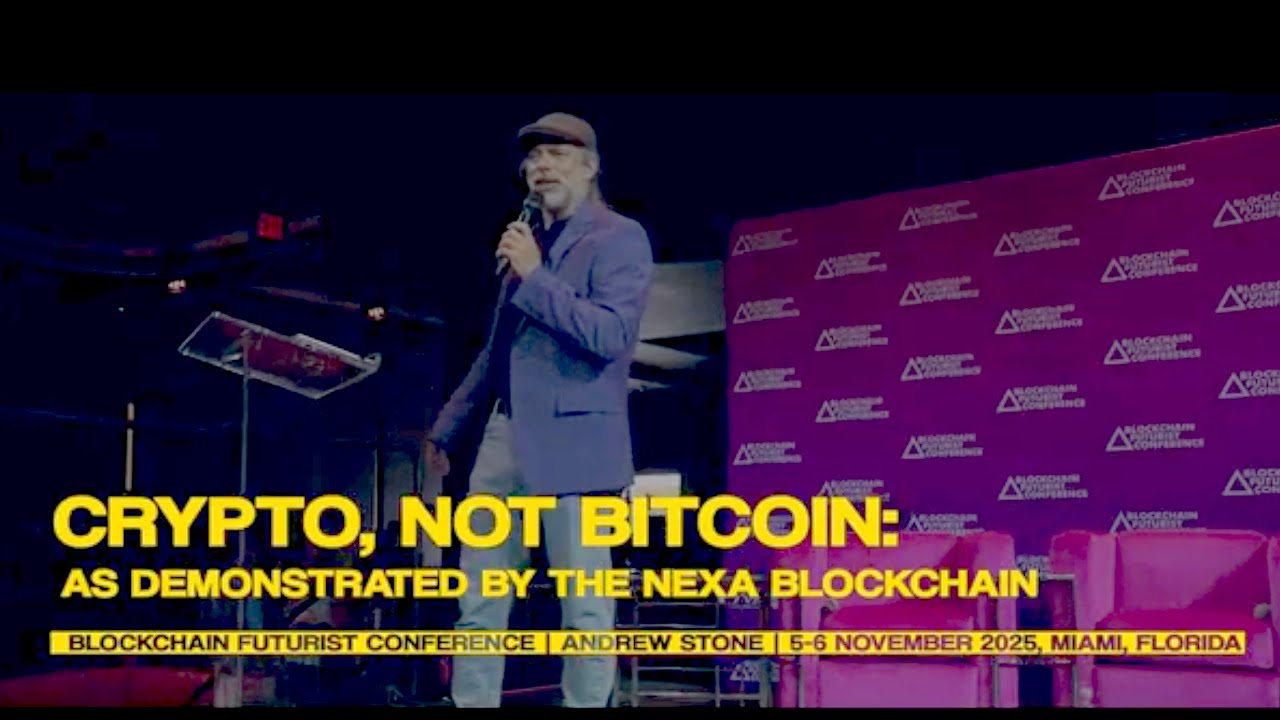
Andrew Stone has been involved in Bitcoin’s technical, political, and economic evolution for more than a decade. In his presentation Crypto, Not Bitcoin, he outlines how Bitcoin has drifted far from its early purpose, shifting from an open, expressive peer to peer system into a tightly constrained, institutionally dominated financial asset. In contrast, the presentation advances a broader vision of crypto as a language for expressing identity, ownership, and exchange, and illustrates how the Nexa blockchain implements this vision today.
Revisiting the Original Mission
The presentation begins by returning to the mindset of early Bitcoin adopters. It highlights a 2011 statement from Roger Ver emphasizing that anyone should be able to send any amount of money to anyone else on the planet, conveniently and without restriction. That early ideal assumed a system that was scalable, permissionless, universal, and expressive enough to support contracts, tokens, and a wide range of peer to peer interactions.
Bitcoin has steadily moved away from this foundation. Contracting capabilities were disabled very early, token functionality was removed shortly after, and the 2016 to 2017 scaling conflict effectively pushed everyday activity off the chain. By 2017, Bitcoin had settled into the identity of digital gold, and by 2024 it had become deeply interwoven with institutional finance through custodial concentration, hypothecation, and ETF based products. The presentation notes the rise of the 2025 slogan ‘Bitcoin Not Crypto’ as a cultural retreat from the broader potential of blockchain technology, summarizing the transformation with a reference to The Who: Meet the new boss, same as the old boss.
Centralization and Crypto as a Language
A wider examination of digital infrastructure places this shift in a broader context. Examples of platform lock in and custodial control are shown, including Amazon’s 2025 FTC settlement and cases where developers abruptly lost access to their GitHub or X accounts. These events highlight the fragility of identity, access, and expression when they depend on centralized intermediaries. This is the type of dependency early Bitcoin intended to challenge.
A key idea emerges: crypto is best understood not as a market category but as a language. In this sense, blockchains serve as tools for publishing verifiable statements about identity, property, and intent to exchange, without institutional approval. If Bitcoin originally aspired to be such an expressive system, Nexa is presented as a continuation of that path.
Identity is used as a concrete example. Demonstrations show how a cryptographically owned identity object can support QR based logins, mobile confirmations, and persistent persona imagery that follows a user across applications. The underlying message is that identity should be portable and user controlled, not granted or revoked by a platform.
Micropayments and Open-Outcry Model
Attention then turns to Nexa.Space, a storage platform that employs micropayments priced by quota and duration. A simple QR interaction settles the cost. This approach revives a long standing idea from early Bitcoin discussions, small payments for small services, which Bitcoin itself has struggled to support at scale.
A further demonstration introduces an open outcry style decentralized exchange. This model is neither a centralized order book nor a smart contract confined to a single chain. Instead, it allows users to broadcast offers through any communication channel. Offers can be shared on message boards, through email or chat, or even posted on socials, and users can then complete atomic swaps directly with one another using a simple QR code interface. An NFT example illustrates how ownership and exchange can arise from ordinary communication, reinforcing the view that freedom of speech naturally includes freedom to transact.
Conclusion
Nexa is described as a financial blockchain and also as a language of identity, ownership, and exchange. The contrast with today’s Bitcoin is intentional, while Bitcoin has become a highly managed financial product optimized for institutional custody, Nexa emphasizes user autonomy, expressiveness, and sovereign control. The early ambitions of Bitcoin are depicted not as lost but as continuing within systems designed to remain open and useful.