Four years ago, Nexa launched with a small group of people, a very ambitious technical vision, and the belief that scalable peer-to-peer electronic cash could be taken much further. Since then, Nexa has grown through changing market conditions, technical challenges, major infrastructure development, new applications, conferences, ecosystem growth, and now its first halving.
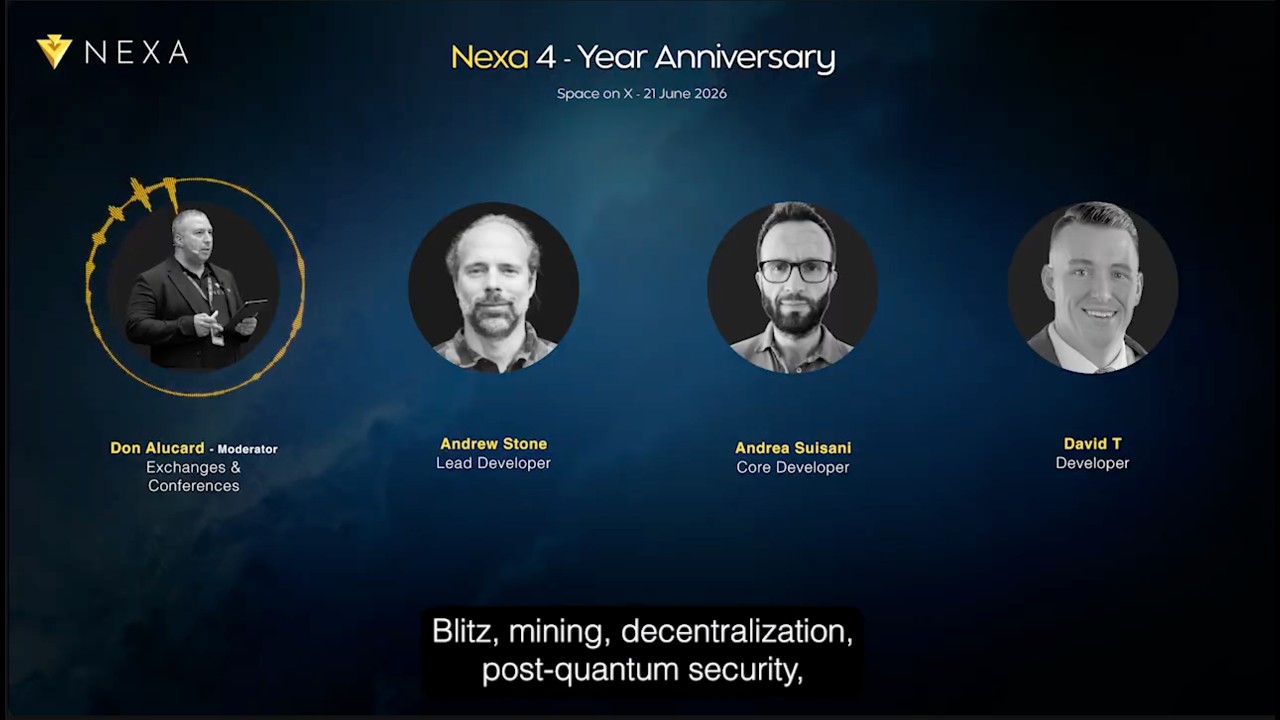
Four years is a meaningful milestone, especially in an industry where projects, technologies, and entire narratives can appear and disappear very quickly. Nexa has continued building through all of it. To mark the anniversary, the team came together for a live Space to look back at the journey, discuss the lessons learned, explore what is being built right now, and think about the direction Nexa takes as it enters its fifth year. Special thanks go to Don Alucard for moderating the event.
Here is a recap of the 4th Nexa Anniversary Space and the full recording:
The First Four Years
What is remarkable about Nexa’s first four years is the dedication of the group of people behind it. Nexa found people who feel this is an important mission, to bring real cryptocurrency that is usable on a daily basis to the world, and who are dedicated to delivering it. This anniversary marks that dedication above everything else.
About a year in, Nexa suddenly started getting a lot of social media attention as a very profitable mining target. CPU miners and then GPU miners were able to get value while mining Nexa. It was like being back in 2011-2013, when mining was an individual project rather than an industrial one. The team’s response says a lot about the project: it kept driving forward and didn’t get swept up in the ephemeral stuff, understanding that the attention was fun and gave great public exposure, but was a moment in time that would move on.
Starting from a new Genesis block brought a sense of freedom: the freedom to add all the things the team thought were valuable then and that are valuable now, after years of constraints that held back what could be done on BTC and BCH. That freedom is still driving the work today.
Being the team in charge of a coin also brought responsibilities that are easy to underestimate. All the applications built on top need library tools that have to be brought about by someone, and that someone has to be you. Even the more mundane things people take for granted, like a decent explorer that sustains all the loads, all the requests, all the API endpoints, require a lot of effort to provide in a professional way.
Nexa reconceived the task as the whole task, from the user interface all the way to the full node and even into the miners, realizing that it is actually the wallet that is in some ways the center of the ecosystem, not the full node. The full node is a workhorse. That repositioning was rewarding, and it was also one of the more difficult areas: it meant building explorers, blockchain databases, and wallets largely without the waves of random contributors that younger projects like early Bitcoin or Ethereum enjoyed. Nexa was positioned to do it all itself, and it really has had to do it all itself.
That is also a large part of Nexa’s longevity. Projects that create one part of the larger ecosystem and think it is the whole thing have come to an ugly end, because there is no one to do the missing part, and those events keep happening lately, even to really established projects. Nexa is still going strong and is a long-term project, and the people building it are heavily invested in it.
The Moments That Shaped Nexa
Nexa has never changed its direction. If anything, experiences at shows and conferences have reinforced it. But some moments strengthened the conviction that creating Nexa was the right choice.
The first hard fork added so many features that some still haven’t been fully used yet: the Merkle calculation that will allow databases on Nexa, and read-only inputs that make certain operations a lot more efficient. They are active on the network, waiting for library code. Features inherited from BCH, like the double spend proof, super useful for any point of sale, and Graphene sit ready as well. It is a statement that Nexa is ready for the goal it has in mind: to let people transact with each other peer-to-peer without any third-party intervention, and be an electronic cash system for the world.
The clearest example is group tokenization. Leading up to Nexa’s launch, the narrative was that NFTs were all just worthless pictures. But a single image as an NFT was one tiny use for tokens. Today the massive necessity of tokens on blockchains has become completely obvious: stablecoins are some of the largest traded entities, giving people access to more stable foreign currencies they previously may not have had. Tokenization was probably the number one technical feature that caused Nexa to fork out of Bitcoin Cash, and it has shown itself to be extremely important.
Four Years of Lessons
Running a live network is close to 24/7 employment. The early period brought a steep learning curve, not about how to develop a full node, but about handling miners and exchanges that previously had multiple reference clients and teams behind them.
One example: nobody anticipated how heavily the wallet that comes with the full node would be used, especially by exchanges and pool miners whose reward address accumulates thousands and thousands of UTXOs. When it was time to withdraw, the wallet couldn’t build a transaction requiring that many inputs. Nexa went through multiple revisions and built automatic wallet consolidation, so that even an address reused for years quietly consolidates in the background and withdraws without problems. More than bugs, these were use cases nobody had anticipated.
Through all of it, one number stands out: Nexa has had 100% uptime over four years. That is an accomplishment all blockchains were supposed to have, but many are not written with the level of quality or dedication of the originals. It validates the decentralized architecture inherited from Satoshi, the redundancy that many chains threw out in their attempts to scale, and it is a testimony to the quality of the work. The codebase carries a heritage going back to 2015, and four years of continuous merges with zero downtime means those merges are good work.
Maintaining Focus
Blockchain has changed dramatically since Nexa launched. Technologies, market trends, and entire narratives have appeared and disappeared, yet Nexa has continued working toward the same long-term goal: an electronic peer-to-peer cash system for the world. Letting people transact with each other without a third party’s permission is the basis of any human right. You can have all the rights you want, but if you can’t pay a lawyer, they don’t matter much. Going back to that basic idea is what carries the project through difficult periods.
Nexa doesn’t chase narratives. The vision behind Wally wallet is that the phone is evolving to be your intermediary, even your avatar, into the digital realm, acting on your behalf as the only secure way to do things. The current world of typed passwords, credit card numbers, and cloud single sign-on is insecure by assumption, and people will lose their entire lives the first time a cloud database of single sign-ons is compromised. Blockchains solved ownership: of money, of identity, of the delegation of powers that can be held by tokens. Nexa is small, but it is implementing answers to these problems, and that is why it has stuck with what it is doing.
Emission.nexa.org: Nexa’s Monetary Story
The same questions kept coming up in the community: when is the next halving, how much Nexa exists today, what will the block reward be in 2030 or 2050. The answers lived in scattered places, and thanks to Sickpig who worked out a spreadsheet from Genesis all the way to the end of emission in 2142. One meticulous document mapping Nexa’s entire monetary policy onto a single timeline.
That document became the source of truth for emission.nexa.org, a live, interactive home for Nexa’s monetary story for which we can all thank Don Alucard. You can watch the countdown to the next halving in real time, drag a timeline from 2022 to 2142, and pick any date in between to see exactly what the network looks like that day. The numbers aren’t predictions, they are scheduled. The protocol has been running since the fair launch four years ago.
The site was also built to feel like Nexa, not just describe it. Every block hash is rendered as a one-of-a-kind sacred geometry mandala, turning the chain into a gallery that updates roughly every two minutes. Every block becomes a chord and every era a different instrument, so you can compose a melody from real Nexa block hashes and listen to the network play itself.
And it launches at a meaningful moment: the first halving just happened. Nexa has crossed the 50% emitted mark, the rate of new Nexa entering the world has been cut in half, and the next four years of scarcity are already written into the code.
Tailstorm
Tailstorm combines ideas from Bobtail and Storm to reduce block time variance, distribute rewards more fairly, and give transactions increasing levels of confidence before a full block is produced. From a research perspective, it works: every day, test networks of full nodes produce thousands of Tailstorm blocks.
The rate of both summary blocks (what you think of today as blocks) and sub-blocks (the Tailstorm DAG) can now be dialed to anything, and the difficulty adjustment algorithm dials right in, from two sub-blocks per summary block all the way up to 120. The initial idea, possibly to be changed in a future hard fork, is the same 120-second summary blocks with 40 Tailstorm blocks per summary block, about a block every three seconds. Run at that configuration, the network is boring, which is exactly what Nexa wants. Pushed harder, sub-blocks in under a second, the DAGs get really interesting and stuff starts to break. That is why the hard fork hasn’t happened yet: the engineering is being done now, and development is deeply into the stability portion. The work is behind schedule, but you don’t rush consensus-critical blockchain code, or you get an outage. Faster blocks will be a great feature, but they are not needed today, and an outage would be a black mark on Nexa. The code is being made really strong instead. One recent example: a mining trick was discovered where a miner could produce new proof-of-work solutions on the same sub-block instead of unique sub-blocks pushing the chain forward, similar to how miners used to mine empty blocks on Bitcoin, and the fix requiring every sub-block in a set to be unique is already being written.
What does Tailstorm mean in practice? Today, Nexa’s two-minute average block time can occasionally stretch to ten minutes, the same way Bitcoin’s ten minutes can stretch to an hour. With 40 sub-blocks averaged into every summary block, the law of averages makes deviation much, much lower: summary blocks arrive much closer to every two minutes. And within about three seconds, sub-blocks show that miners have already started mining your transaction. Unlike competing techniques that rely on network claims and subsequent punishment, in Tailstorm miners can’t lie about mining your transaction, because they are putting proof-of-work behind the claim. For real daily use (the coffee counter, the in-person payment), a couple of sub-blocks will be sufficient confidence, at speeds on par with centralized chains that aren’t really blockchains. And after they are a few blocks deep, sub-blocks are completely forgotten, leaving only a few extra bytes of proof in the summary block, minimal impact on the size of the blockchain.
There are no unsolved theoretical challenges left, no equivalent of lightning’s unsolved dynamic routing problem. What remains is adversarial testing: throwing double spends, illegal transactions, and trash at an isolated Tailstorm network and seeing what shakes out.
Nexa AI
Artificial intelligence is changing how people write software, and for blockchain ecosystems this is especially significant, because the technical barrier to building useful applications has always been very high.
Nexa’s conclusion is blunt: the dev kit is probably dead. No one is going to use a website tutorial to get into a product development cycle anymore. People want to go to an AI, type a couple of lines, and have it produce the basic bones of an application. Even an expert developer might as well have AI get them started; a product person can go 100% AI.
So Nexa is retooling its dev kit around people using AI to rapidly create applications, hoping to steal a march on other blockchains. The goal: type into Claude “create an app like this, and accept Nexa using my idea,” and have it magically work. That could make Nexa the easiest way to accept money. You will never be able to type that into an AI and have it work with credit cards, because the permissioned system that guards makes it impossible.
Concretely, a Kotlin Multiplatform starter application is being retooled with basic blockchain connectivity, wallet connectivity, and the ability to easily send transactions between the platform and an external wallet. AI-agent-specific tools (skills) are being developed to make the process easier for anyone intimidated by staring at a large codebase, with content for community builders coming shortly.
A word of caution comes with it: these are financial applications. Use the testnet infrastructure, and be very careful with AI-generated code on the money path: transactions, smart contracts. A human review of the critical code paths is always better; AI drives you in the correct direction, then you go back and review.
Nexa also has a structural advantage here: no blind signing problem. If AI screws up an application horribly, it shows up in the person’s wallet. Wally will ask “do you really want to transmit 6 billion Nexa to this site?” and you click no. In Ethereum’s blind signing model, you authorize the website to run an opaque transaction and hope it does what it is supposed to.
The same thinking extends to AI agents as economic actors. Agentic browsing is growing fast, and agents need money to use services. Nexa’s instantaneous, very cheap transactions are a natural fit. The core of the protocol already exists in TDPP: guardrails on a trusted agent, so an AI can spend no more than a set amount per day from your Wally account without Wally popping up a dialog asking you to authorize more. A much safer model than handing the AI the keys to your wallet.
The Quiet Work
Some of the most important work happens away from the big announcements. Two examples:
A new capability just landed in a library: sending money to people without reusing the same address, by sharing an HD wallet xPub from which additional addresses can be derived. Small enough that it doesn’t generate much excitement, and applications can use it today.
A second feature waits on the hard fork: signing a range of inputs and outputs in a transaction while allowing other entities to move where those inputs and outputs land in the transaction array. No other blockchain, as far as Nexa knows, allows this mobility of outputs after signing. It means two transactions that previously couldn’t be combined, for the prosaic reason that output zero is different, now can. Nexa will use it in the DEX and other peer-to-peer partial transaction interactions.
The Fifth-year Challenge
Nexa’s first four years built the technical foundations. The next stage is connecting those foundations with users, developers, businesses, and applications that create lasting activity, one of the hardest challenges in blockchain, because strong technology does not automatically result in adoption.
The whole project is transforming from being focused on the full node to delivering fun and interesting applications that use Nexa. Some are wild shots in the dark that at minimum demonstrate capability, and at maximum might become a successful game or application or DEX on their own. More developers now work on applications and the AI architecture than on the full node, which also explains, honestly, why Tailstorm is delayed: it is not the highest priority right now.
Nexa has watched two failure modes in cryptocurrencies. One: create SDKs and wait for people to build apps, and people don’t. Two: pay a group to build one top-heavy app, then sit and wait while the money runs out, because blockchain adoption takes time. Nexa is doing neither. It builds the tools it needs, in a way other people can use, and uses them to build its own applications. When an application is done, the developers move on to the next idea rather than waiting for adoption. Eventually these apps pull in users across the ecosystem, and maybe one goes viral. But all of them will be there, available, ready to go.
Into Year Five
Nexa is finally doing what it came here to do. Part of what drew this team into cryptocurrency in the first place was a simple, absurd experience: moving money to a prototyping factory in China took longer than it took the factory to build the product and overnight it across the world. The intention was always to use crypto, and Nexa is now at the point where real uses are being built out.
Success won’t be measured by what the wider blockchain industry thinks. The measure is some random community (trading collectibles, whatever it may be) saying: “you should install this Nexa wallet, because you get an NFT for each item, and once the NFT is transferred, the item just appears in the mail a few days later.” Nexa as the thing you just use to make it happen.
Four years in, Nexa has moved from an ambitious idea and a small group of contributors into a battle-tested network supported by a growing team, a committed community, an expanding collection of tools, and increasingly visible applications. The first halving is behind it, the base layer keeps improving, new approaches to mining and transaction security are being explored, long-term challenges such as quantum computing are being prepared for, and Nexa’s technology is turning into products people can actually experience.
The fourth anniversary is not the conclusion of the story. It is the beginning of another chapter. Happy fourth anniversary to Nexa, to the team, to the community, and to everyone who has been part of the journey.