Block reward halvings are foundational mechanisms in proof-of-work monetary systems, governing the rate of coin issuance and the long-term evolution of network security incentives. In Bitcoin and Bitcoin-like protocols, halvings are deterministic transitions embedded in consensus rules to ensure predictable supply, declining inflation, and an eventual shift toward fee-funded security. As Nexa approaches its first protocol-enforced halving, the event provides a timely opportunity to examine its monetary mechanics, security budget implications, and on-chain scalability model in a unified framework.
Protocol-Enforced Halving Mechanics in Nexa
Nexa employs a Bitcoin-like monetary framework in which block rewards are governed by a protocol-enforced halving mechanism. Nexa targets a block interval of approximately 2 minutes, roughly five times faster than Bitcoin. Under this design, a halving event occurs at intervals of approximately 1,050,000 blocks, at which point the mining subsidy is reduced by 50%. This mechanism is hardcoded into the consensus rules and operates automatically, without reliance on governance decisions or discretionary intervention. Absent a consensus-level protocol change adopted through a network upgrade, Nexa’s issuance schedule is non-discretionary and fully verifiable by all participants.
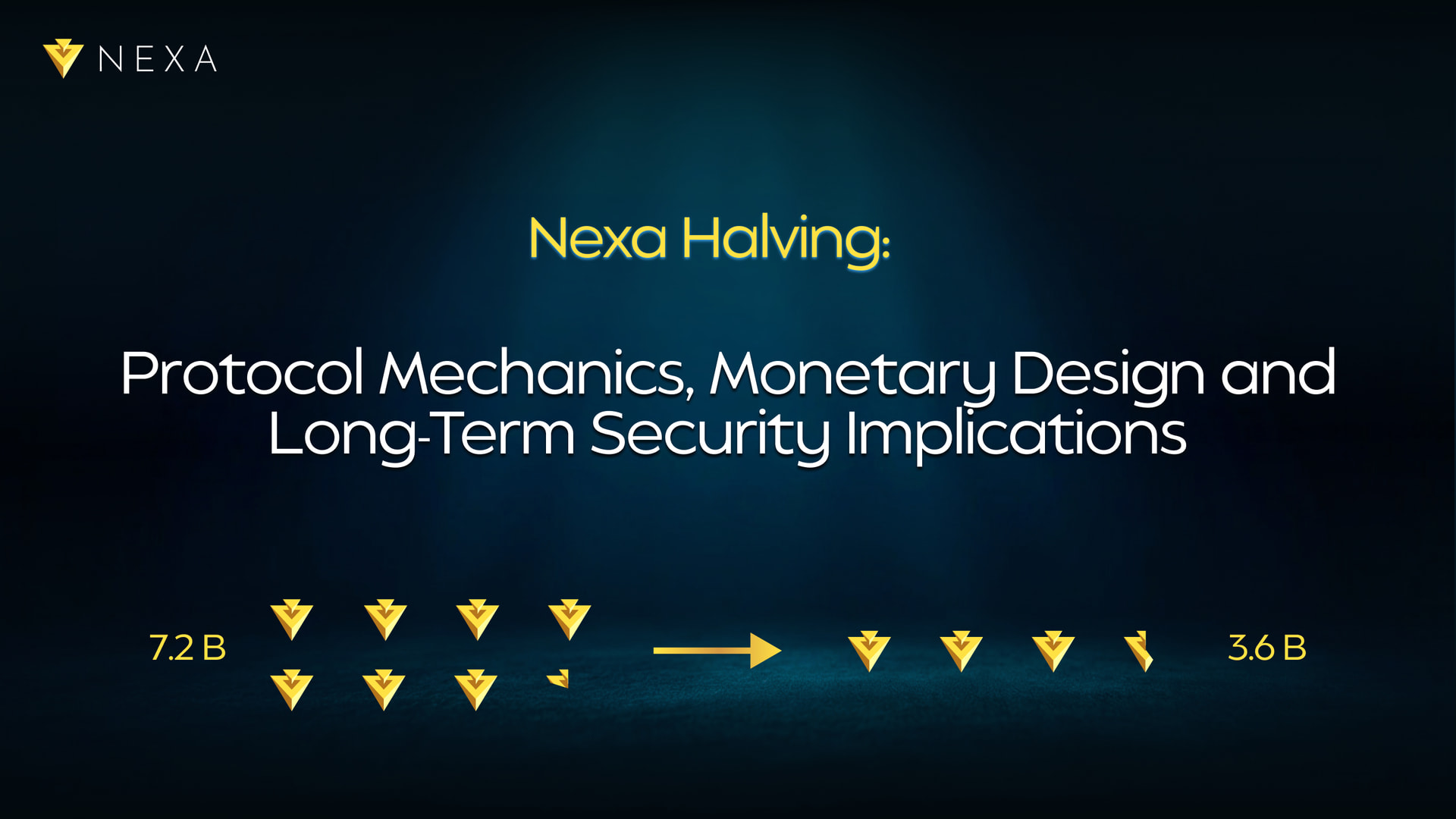
At present, the block subsidy is set at 10,000,000 NEXA per block. The first halving is expected to occur around 1 May 2026, based strictly on block-height progression rather than calendar-based scheduling. As a result, the estimated date may vary with changes in aggregate network hashrate. Upon activation of the halving, the block reward will decrease uniformly across the network to 5,000,000 NEXA per block. Subsequent halving events will continue this pattern, progressively reducing the rate of new issuance while applying identically to all miners through consensus rules.
Predictable Supply and Declining Inflation
A defining property of proof-of-work monetary systems is the enforcement of a predictable supply schedule. In Nexa, issuance rules are publicly transparent and deterministic under the current consensus framework, enabling participants to form long-term expectations regarding total supply, issuance rates, and monetary dilution. This predictability reduces monetary uncertainty and governance risk relative to discretionary issuance systems.
Inflation in Nexa is mechanically defined as the rate of new coin issuance through block subsidies. During the early stages of the network, inflation is intentionally higher in order to incentivize miner participation, distribute coins broadly, and bootstrap network security. Through successive halving events, issuance declines in a controlled and transparent manner, enabling a gradual transition from early-stage growth incentives toward long-term monetary stability.
Block Rewards, the Security Budget, and Incentive Compatibility
In proof-of-work systems, the security budget is defined as the total miner compensation per unit time, comprising block subsidies and transaction fees. This budget represents the economic cost required to reorganize or attack the chain and is therefore a primary determinant of network security. Under Nexa’s Tailstorm-based design, the security budget is realized not only through traditional summary blocks, but also through the cumulative proof of work contributed by subblocks.
Miners incur real-world costs, including energy expenditure, hardware depreciation, and operational overhead, to produce proof of work. Nexa’s block subsidy functions as a security subsidy during the network’s growth phase, compensating miners when transaction fee revenue alone is insufficient to cover these costs. Within each mining round, miners solve many lower-difficulty proof-of-work puzzles in the form of subblocks, with the final subblock simultaneously serving as the summary block that advances the canonical chain. The total security contribution therefore reflects both the summary block itself and the referenced subblock proofs of work, preserving a linear notion of accumulated chainwork while benefiting from lower variance and faster signaling.
This incentive structure assumes rational miner behavior, whereby hash power allocation responds to expected revenue net of operational costs. By cryptographically binding subblock proofs of work to their parent summary block and preventing proof-of-work reuse across rounds, the protocol ensures that miners cannot cheaply fabricate or replay security contributions. As long as miner compensation, whether derived from subsidies or fees, remains commensurate with the cost of producing valid proof of work, honest participation remains the dominant strategy. In this way, the security budget, incentive compatibility, and consensus integrity remain aligned as issuance declines over time.
Halving and the Structural Transition Toward Fee-Based Security
By construction, Bitcoin and Bitcoin-like proof-of-work systems cannot rely indefinitely on newly issued coins to fund network security. As block subsidies decline through successive halving events and asymptotically approach zero, miner compensation must increasingly rely on on-chain transaction fees in order to sustain an adequate security budget. This transition is a direct consequence of a finite issuance schedule and declining inflation over time.
Halvings provide a structured and predictable mechanism for enabling this shift. Rather than eliminating issuance abruptly, they progressively rebalance miner incentives away from inflation-based rewards and toward usage-based revenue derived from transaction fees. Over the long term, this design internalizes security costs into network activity itself, such that users who consume block space and settlement services contribute directly to the funding of the computational work required to secure the ledger.
Whether fee markets alone can fully sustain long-term security remains an open empirical question. The outcome depends on sustained transaction demand, the structure and competitiveness of fee markets, and the extent to which economically meaningful activity remains on-chain. As a result, the effectiveness of the fee-based security model is ultimately observable over time as networks mature and subsidy-derived revenue declines.
Nexa’s High-Scalability, On-Chain Fee Model
Nexa is structurally positioned to support this transition due to its emphasis on high Layer-1 scalability. The protocol enables large volumes of transactions to be processed directly on-chain, rather than constraining block space and relying on off-chain execution, Layer-2 systems, or payment-channel networks to achieve throughput. By scaling at the base layer, Nexa preserves a direct economic relationship between transaction activity, fee generation, and miner incentives, ensuring that security funding remains closely coupled to on-chain usage.
In constrained block-space models, transaction fees tend to emerge primarily through artificial scarcity, where limited capacity forces users to compete for inclusion. In contrast, Nexa’s design allows fees to emerge through transaction volume, enabling meaningful aggregate fee revenue even when individual transaction fees remain low. Conditional on sustained demand for on-chain settlement, this volume-driven model supports a gradual and viable shift toward fee-based miner compensation without sacrificing accessibility or efficiency. Importantly, economic activity and security funding remain unified on the same layer, preserving the original proof-of-work incentive structure.
Why the Nexa Halving Matters
In proof-of-work monetary systems, a halving is economically meaningful only insofar as it constitutes a binding, irreversible reduction in issuance enforced by consensus rules. Unlike discretionary monetary adjustments, a protocol-level halving alters the long-run trajectory of supply growth and directly affects the composition of the network’s security budget. Its significance lies in its role as a mechanism that progressively constrains inflation and forces the system to transition toward alternative sources of miner compensation.
A halving incrementally shifts the composition of miner revenue away from issuance and toward transaction-derived fees. This shift is central to the long-term viability of any proof-of-work system with finite supply. If security were to depend indefinitely on newly minted coins, the system would require perpetual inflation. By contrast, a halving enforces a gradual reallocation of incentives, aligning security expenditure with actual network usage over time.
The importance of the Nexa halving therefore lies in its function as a structural transition. It marks the beginning of a sequence in which successive reductions in issuance progressively confirm whether the network’s design can sustain adequate security as inflation declines. In this sense, the halving is an essential component of Nexa’s monetary and security model, through which long-term sustainability is empirically evaluated rather than assumed.
Conclusion
The Nexa halving is a consensus-enforced event that reduces block rewards at fixed intervals, systematically lowering inflation while preserving miner incentives. Enabled by high on-chain scalability, Nexa is well positioned to transition from inflation-funded security toward a fee-driven model grounded in real economic activity. As the first halving approaches, it serves as a concrete demonstration of Nexa’s long-term design objectives: predictable supply, incentive-compatible security, and fully on-chain economic settlement.