Nexa began the new year with a strong focus on reflection, technical progress, and forward-looking research. January opened with a panel discussion in Florida featuring Andrew Stone, alongside a comprehensive retrospective of the previous year’s development. Following the conclusion of 2025, the team took the opportunity to review milestones achieved and to contextualize ongoing work. At the same time, several in-depth publications were released, covering topics such as post-quantum migration strategy, Counterparty and Protocol Discovery (CAPD), and an analysis of Nexa’s halving mechanism. As January enters its second half, this overview summarizes the key developments of the month to date.
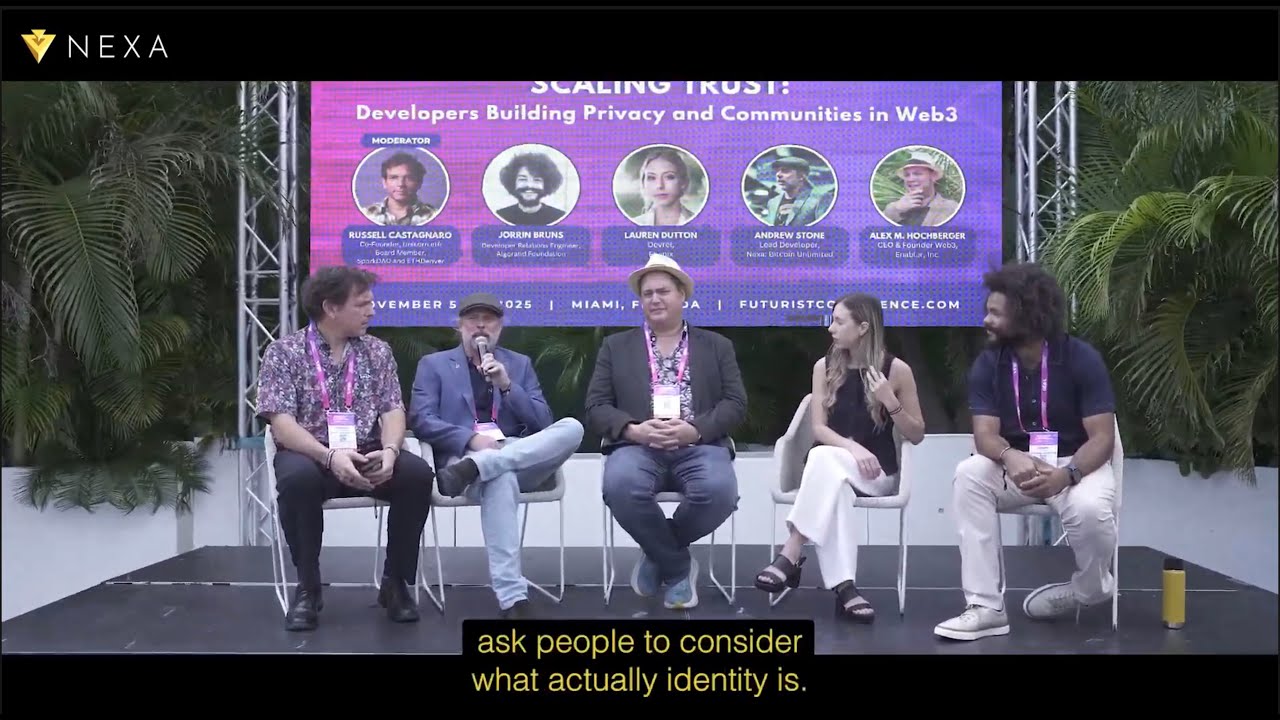
Web3 Trust & Privacy Panel with Andrew Stone | Futurist Conference Florida 2025
Nexa wrapped up a strong showing at the Blockchain Futurist Conference Florida 2025 as a Gold Sponsor. The event took place on 5–6 November 2025 at the Hard Rock Guitar Hotel & Daer in Miami and brought together blockchain researchers, builders, exchanges, and industry leaders from across the Web3 space. As part of the conference program, Nexa Founder and Lead Developer Andrew Stone joined the panel “Scaling Trust: Developers Building Privacy and Communities in Web3”, where the discussion focused on practical challenges around privacy, trust, and the design decisions developers face when building scalable blockchain systems.
Read more:
Nexa 2025 Chronicle: Built to Scale
Throughout 2025, the Nexa ecosystem saw steady progress across development, research, and community engagement, alongside participation in major industry events and growing global awareness. With the year now complete, the team compiled a consolidated review of the past twelve months, bringing together key updates from the monthly newsletters into a single, structured recap. The chronicle highlights major milestones while providing a clear picture of how the project continued to build toward long-term scalability and resilience.
Read more:
Quantum Threats to Blockchain Security and the Nexa Post-Quantum Migration Strategy
Quantum computing has long been viewed as a distant concern for blockchain security, but that assumption is becoming harder to maintain. Recent advances in hardware, improved estimates of quantum capabilities, and national development roadmaps have shortened the timeline for potential risks to widely used cryptographic systems such as RSA and elliptic curves. Because cryptocurrencies permanently expose public keys and signatures on public ledgers, they face unique challenges in this area. In parallel, post-quantum signature schemes like FALCON have matured to the point where real-world deployment is feasible, and Nexa is actively preparing a full post-quantum migration path ahead of much of the industry.
Read more:
Nexa Counterparty and Protocol Discovery (CAPD)
Many crypto-financial protocols struggle with counterparty discovery, especially when operating in trustless, anonymous, peer-to-peer environments. Unlike long-running network nodes, these interactions are often short-lived and require finding a very specific match rather than any available participant. This makes the discovery phase a critical but often overlooked part of the user experience. Use cases such as coin mixing, atomic cross-chain swaps, and short-duration trades all benefit from more precise discovery mechanisms. The same applies to service discovery, such as locating servers with specific capabilities, which highlights the broader need for a structured approach like CAPD.
Read more:
Nexa Halving: Protocol Mechanics, Monetary Design, and Long-Term Security Implications
Block reward halvings play a central role in proof-of-work systems by shaping coin issuance, inflation, and long-term security incentives. In Bitcoin, Nexa and similar protocols, halvings are built into consensus rules to provide predictable supply dynamics and a gradual transition toward fee-based security. As Nexa approaches its first protocol-enforced halving, the event offers an opportunity to review how its monetary design, security budget, and on-chain scalability model fit together, and what this milestone means for the network’s long-term operation.
Read more:
To Wrap Up
The team’s commitment entering 2026 remains stronger than ever. A substantial number of planned developments are expected to reach completion over the course of the year, and the Nexa team looks forward to delivering further releases and protocol updates as they become available. In the meantime, development continues throughout the remainder of the month, with a full review of upcoming progress to follow at the end of January.