Imagine a microchip that can do the same thing as your software node, but is faster, more reliable, uses less energy, and can be built for a fraction of the cost. This is not a distant dream, but the direction Nexa has been working toward for years.
Nexa Chief Scientist, Dr Peter Rizun, designed Blitz, a hardware which verifies digital signatures and removes the dominant compute bottleneck for scaling cryptocurrencies.
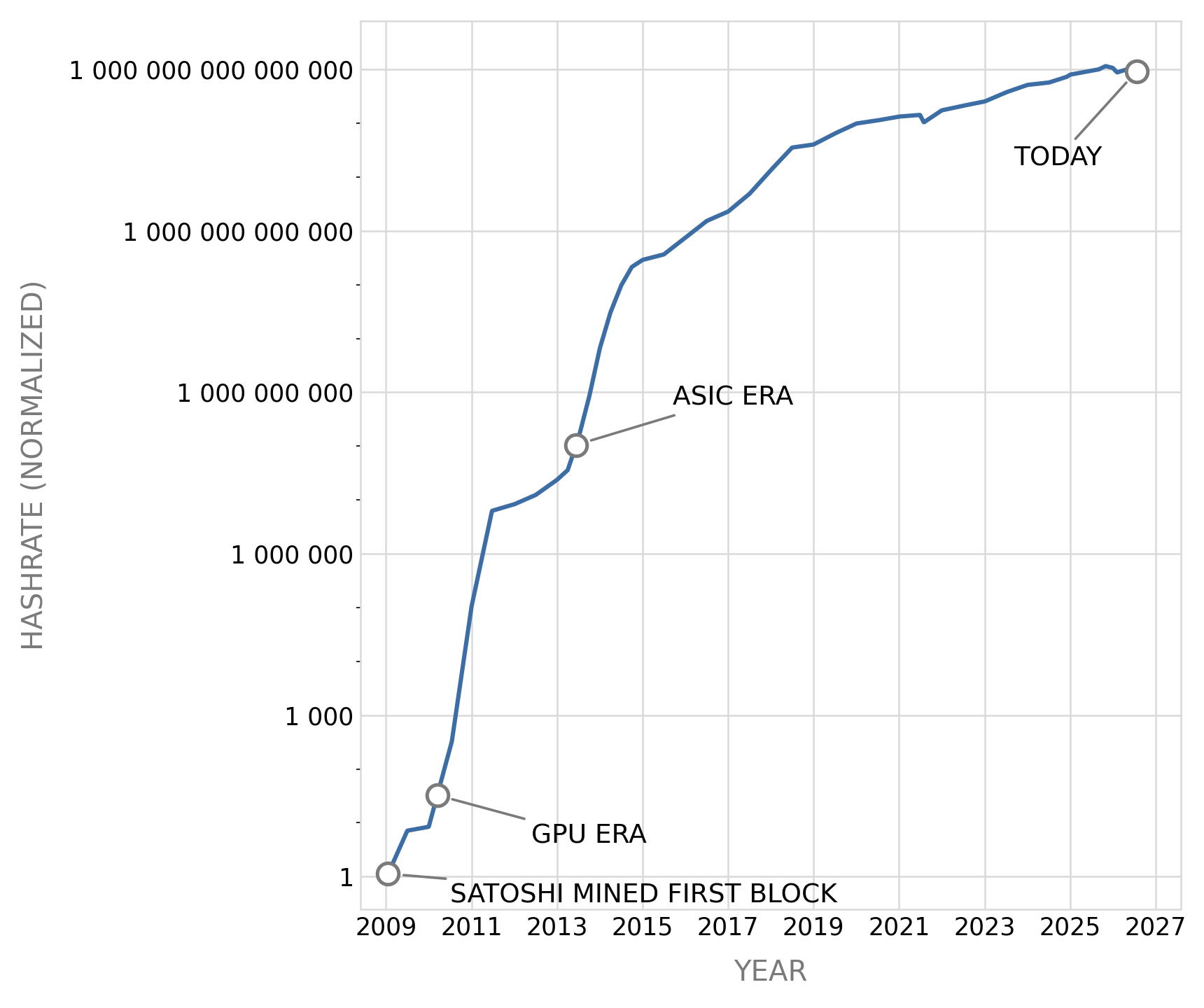
To understand the benefit of hardware acceleration, we first need to go back to when the first Bitcoin block was mined. Since then, the technology has improved more than 1,000,000 times, and the same improvement can be reached in scaling cryptocurrencies.
The Precedent
The hardware approach has already paid off once in cryptocurrency history. Satoshi mined the first Bitcoin with his CPU on January 3rd, 2009. Shortly afterwards, people realized they could mine faster and earn more profit by programming a GPU to do the mining instead. Later still, innovative people figured out how to make an electrical circuit for mining and etched that circuit onto a tiny silicon die. The era of the ASIC miner was born. And every year, mining companies come out with new, faster, lower-power, and cheaper mining rigs as they compete to find the next block.
The efficiency of the technology increased tremendously. Satoshi’s Intel i7 could do about a hundred thousand hashes for every joule of energy consumed. The first GPUs could do about 1.2 million hashes per joule. The first ASIC miners could do about 500 million hashes per joule. And by 2026, the best ASIC miners could do about 105 billion hashes for that same joule of energy. That is a 1,000,000-fold improvement in the technology since 2009. (1,2,3)
Think about that number for a moment. There are very few technologies in human history that improved a million-fold in seventeen years. Bitcoin mining is one of them, because the incentives of proof-of-work created a relentless, global, free-market competition to do one specific computation better than anyone else.
The Problem
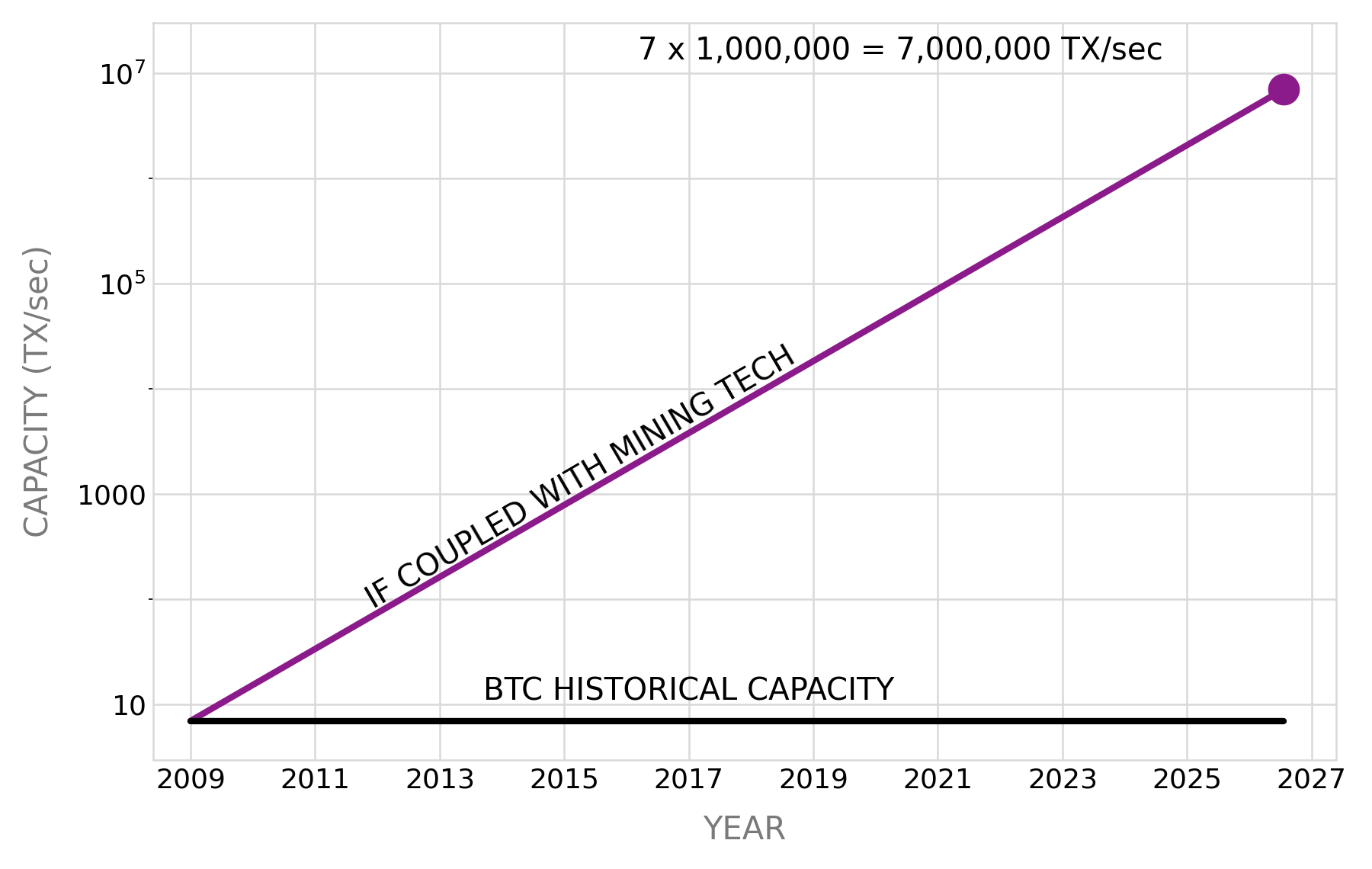
Here is the uncomfortable part: while mining efficiency improved 1,000,000 times, the network’s capacity in transactions per second flatlined. It was seven transactions per second a decade ago, and seven transactions per second in the days of Satoshi. If transactions per second had improved in lockstep with the progress in mining chips, Bitcoin would be at 7 million transactions per second today.
So why aren’t miners supporting the network? Why aren’t they building better, faster nodes that allow the network to actually scale? It’s obvious that Satoshi wanted them to.
“This [newly mined coins] adds an incentive for nodes to support the network” – Satoshi Nakamoto, Bitcoin white paper, 2008
The answer Nexa arrived at is nuanced: proof-of-work was the right idea, but Satoshi picked the wrong hash function. Rather than dumb hashing, the hash function should have been chosen so that a miner’s hash rate matched the rate at which that miner could validate transactions. If that had been the case, the massive improvements we’ve seen in mining technology would have been coupled to equally impressive improvements in full node technology.
In other words, the greatest hardware-acceleration engine ever created, proof-of-work incentives, spent seventeen years accelerating a computation that does nothing for the network’s capacity. All of that ingenuity, all of that silicon, all of that energy, pointed at hashing instead of at the two things a money network actually needs at scale, checking signatures and looking up coins.
The Evidence
Before Nexa existed, the team behind it went and measured the problem. In 2017, Bitcoin Unlimited’s Gigablock Testnet Initiative built a global test network to find out what actually limits a blockchain’s throughput. The result was clear at the time and has stayed true since: when the network crossed roughly a hundred transactions per second, mempools began to lag behind. It was never able to sustain more than about five hundred transactions per second, and the bottleneck wasn’t bandwidth. As the team put it at Scaling Bitcoin at Stanford: we’re limited by the software, not by the size of the pipes.
That testnet went on to mine the world’s first gigabyte block. But the deeper lesson was the one that shaped everything Nexa does with silicon today: if software is the ceiling, then the ceiling itself has to change. You can optimize software for years and win percentages, but hardware wins multiples.
The Philosophy
From day one, Nexa’s proof-of-work was designed around a contrarian question. Most cryptocurrencies treat ASICs as an enemy, something to resist with “ASIC-proof” algorithms. Nexa’s mining specification takes the opposite view: instead of assuming specialized hardware is bad, why not use the profit potential of mining to encourage the development of exactly the hardware the network wants?
That is why Nexa’s proof-of-work has, from launch in 2022, included a digital signature operation, the same kind of operation a node performs when it validates your transaction, inside the mining puzzle itself. Mining Nexa was designed as a bounty: whoever builds silicon that does the network’s real work faster wins more blocks. Hash-per-second mining, coupled directly to transactions-per-second validating. However, what time taught us was that the signature operation is an elliptic-curve point multiplication, and that is work GPUs already do well, so the bounty was captured by graphics cards instead of driving new node hardware. Now the mining algorithm is being redesigned to tie the puzzle more tightly to the network’s real work and add coin-lookups in a later hard fork, to incentivize the bounty again and keep pushing hardware acceleration forward.
The goal is to reproduce, deliberately, what happened to Bitcoin mining by accident. Bitcoin mining hash power grew by a thousand trillion times. Nexa wants to make that happen for node technology, to make Satoshi’s vision a reality and have peer-to-peer electronic cash for the entire world.
And this competition is meant to be open as Nexa specifies the protocol and creates reference implementations, but anybody is free to optimize on them. If someone out there can build better Nexa hardware than we can, that makes the whole network better.
Two Arrows, One Target
The effort runs on two tracks at once; the first is top-down, the effort Andrew Stone leads: taking the proven Satoshi codebase (software with over a decade of heritage) and pushing it further: more throughput, better protocols, new capabilities. That’s the full node you can download and run today, the software that has kept Nexa’s blockchain at one hundred percent uptime since launch.
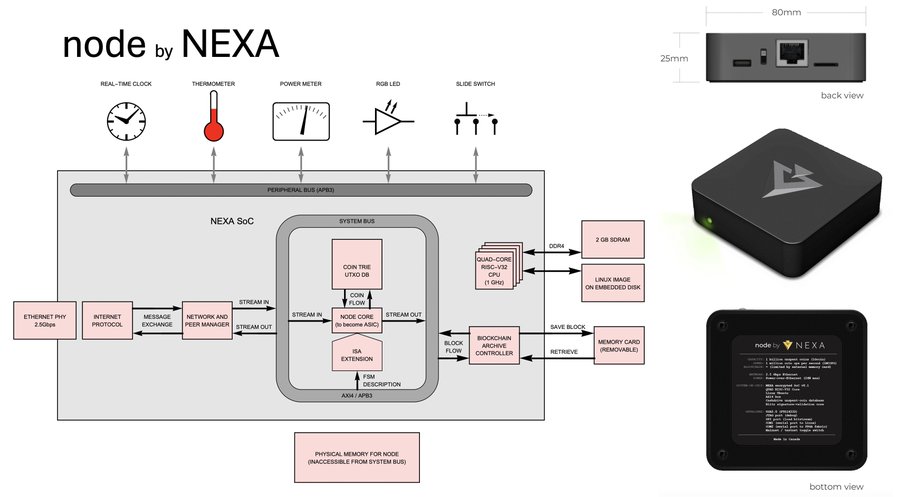
The second is bottom-up: Dr Peter Rizun is implementing what Satoshi described in the white paper directly in hardware. Building a node as a circuit of digital logic gates: wires, gates, and registers doing what your software node does, in hardware, at silicon speed.
The hope is simple to state: when these two arrows converge, Nexa will have achieved its goal of building a better Bitcoin.
Sources
-
The Bitcoin white paper: Satoshi Nakamoto, “Bitcoin: A Peer-to-Peer Electronic Cash System,” 2008, https://bitcoin.org/bitcoin.pdf.
-
Efficiency figures behind the 1,000,000-fold number: the Bitcoin Wiki. (1) ASIC figures at Mining hardware comparison - Bitcoin Wiki, (2) CPU and GPU figures at Non-specialized hardware comparison - Bitcoin Wiki. (3) Current best-in-class ASIC efficiency, Bitmain Antminer S23 Hydro at 9.5 J/TH: Bitmain Antminer S23 Hydro | Bitcoin Miner Profitability | HashrateIndex.
-
Gigablock Testnet throughput results and the “software, not the pipes” line: Scaling Bitcoin '17 (Stanford) presentation at https://www.youtube.com/watch?v=5SJm2ep3X_M.
-
Efficiency ladder, the two-tracks framing, and the node by Nexa hardware: Peter Rizun, “A New Chapter in Scaling: Cryptocurrency-specific integrated circuits,” Australian Crypto Convention, Sydney, 23 November 2024. Transcript: https://x.com/PeterRizun/status/1870870882559893626.
-
Blitz as an FPGA-based signature-verification engine (Efinix Titanium): Blitz — A digital-signature verification engine for the NEXA software.