In the last article we met Blitz, the card that takes signature checking off the CPU. We closed with a bigger question: what happens when you put the whole node inside an FPGA?
We don’t like running a node on our main desktop machine, especially if it is bogging down all cores and the fans are blazing and the office is heating up. We want to run it on a tiny little node that we plug into the router and just SSH into when we need to. That is the long game of this series: building a microchip for cryptocurrency, a microchip that can do the same thing as your software node, but is faster, more reliable, uses less energy, and can be built for a fraction of the cost. That chip is still ahead of us, but there is a lot of useful things we can do directly in hardware in the meantime.
Node by Nexa
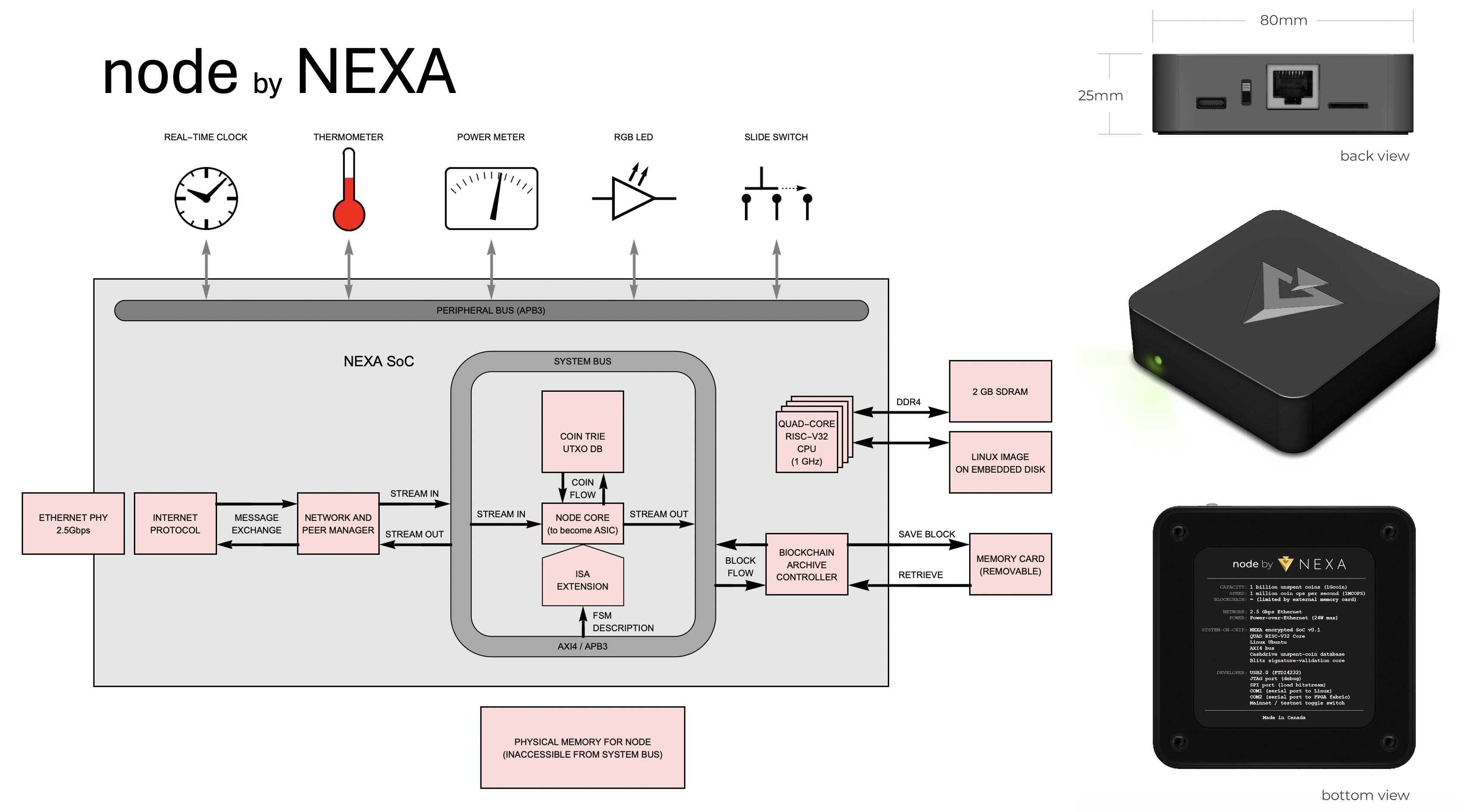
This is Node by Nexa, as Nexa Chief Scientist, Dr Peter Rizun, showed it at the Australian Crypto Convention in Sydney in 2024. It is a small hardware-accelerated cryptocurrency full node. It has a network connector, a removable memory card for storing the blockchain, a switch to toggle between mainnet and testnet, and a USB port for debugging and loading new FPGA bitstreams.
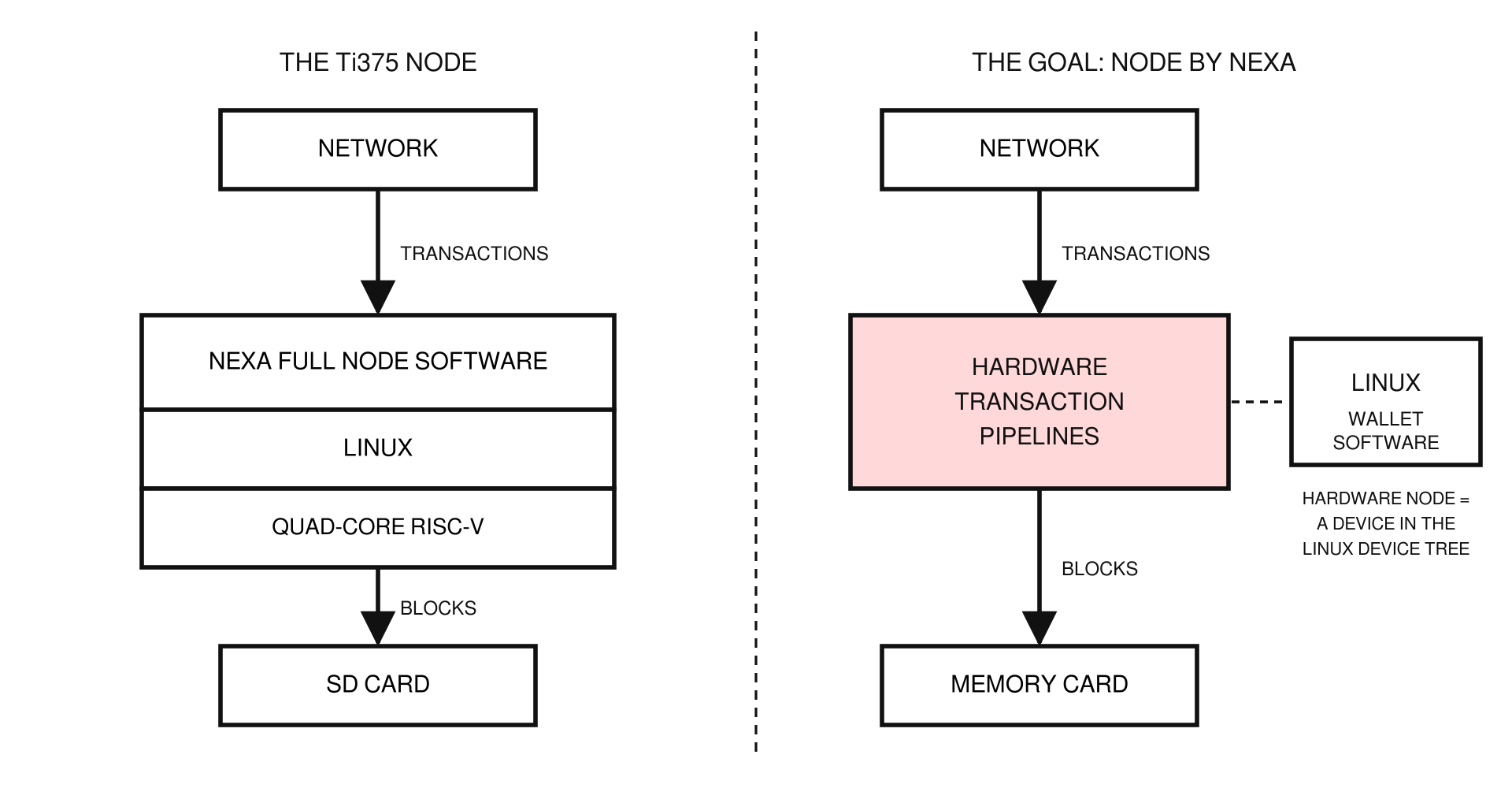
The heart of the node is the Nexa System-on-Chip. In addition to a large amount of reconfigurable FPGA fabric, this SoC contains a quad-core RISC-V processor running at 1 GHz, which boots into Linux. But the idea is not to actually use Linux for the full node. We want to get to the point where the full node exists purely in hardware, so transactions come in over the network, are routed through our hardware transaction pipeline, and blocks are written to the memory card, without any intervention by the operating system. This way, the data pipelines remain purely in the hardware domain where they are very fast.
From the Linux perspective, the hardware node is a device in the Linux device tree. Wallet software running on the Linux side could talk to the hardware node to get updates on balances, or to broadcast transactions into the network. This truly is a cryptocurrency computer.
With Blitz, custom silicon can already become part of your computer. Our Blitz FPGA verifies secp256k1 signatures, and to Linux it’s a regular file: open /dev/verify, write 160 bytes, read back 1 byte, PASS or FAIL.
A Few Thousand Lines of Verilog
The hardware node itself is the Bitcoin node implemented as an electrical circuit purely in hardware with no CPU and no software. In December 2024 Peter posted an article about our progress, and summed it up in one comment.
“What surprised me was just how simple the core bitcoin node is when implemented directly in hardware. It’s just a few thousand lines of Verilog and can be implemented with fewer than 10 million transistors.” – Dr Peter Rizun, r/btc, 22 December 2024
Peter started this project by making a hardware UTXO database he called Cashdrive, in 2020. He soldered some chips together and synthesized some electronic circuits on a field programmable gate array: a proof-of-concept for a bitcoin UTXO database that would help a laptop computer keep up at global scale transaction throughput. Cashdrive has no software, 0 lines of code. The UTXO database is controlled with combinational logic gates and flip flops. It scales horizontally with hardware cells that operate in parallel. He started working on Cashdrive because he was worried that the UTXO database wouldn’t scale. But it scales fine up to millions of transactions per second and trillions of outputs.
Then we made a hardware Schnorr signature verifier with an ultra-fast elliptic curve point multiplier on secp256k1, the line of work that became Blitz. Peter was intimidated by the thought of implementing the full node in hardware, but it was turning out easier than both the signature verifier and the UTXO database. Along the way the tree structure needed to change from a Merkle tree to a compact bitwise prefix tree, in order to get something we could build in hardware that still met our scalability requirements, which is the story the third article in this series told.
A Full Node on Four RISC-V Cores
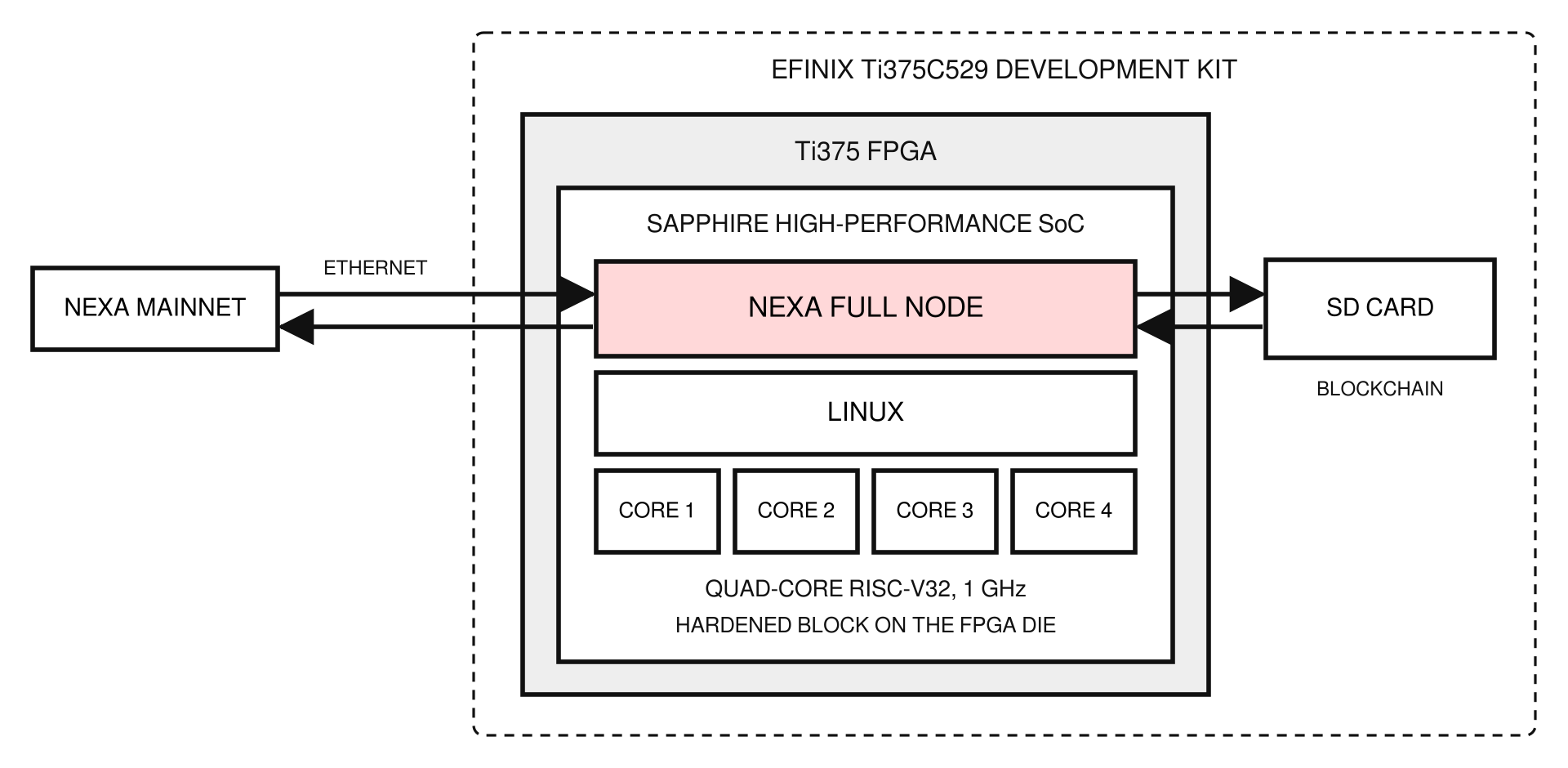
The quad-core RISC-V processor running at 1 GHz, which boots into Linux. The Efinix Ti375, the same FPGA that the Blitz card carries, ships with it as a hardened block on the die, and we have already run the Nexa node software on it.
Between October 2024 and May 2025 we did something genuinely cool: we booted Linux on the Efinix Ti375C529 dev kit’s Sapphire SoC, a quad-core RISC-V32 at 1 GHz, and ran a real Nexa full node on it: a full node inside an FPGA and it synced mainnet blocks over Ethernet. This is building our own computer inside a FPGA, so that people can start to understand what we’re doing and try it themselves.
Getting there meant cross-compiling a large C++ application, a Bitcoin-family node, for riscv32. No distro-packaged riscv32 toolchain exists, so the port uses buildroot’s own SDK. OpenSSL 1.1.1 has no riscv32 support, so the port drops BIP70 to remove it. And the RTC resets to Jan 1 1970 every boot, which trips nexad’s block database contains a block which appears to be from the future check; shipping ntpd in the image fixes it.
Nexa 2.0 also came with expanded platform support, including new compatibility with RISC-V architectures, and today this is a demonstration that it works.
In Conclusion
While Andrew Stone leads a top-down effort building off of the Satoshi code base, Peter Rizun leads a bottom-up effort implementing what Satoshi described in the white paper directly in hardware, without writing any software, or even using a CPU. Instead, building a node as a circuit of digital logic gates.
In Node by Nexa, the two arrows meet on one chip: the node software on the RISC-V cores, and the hardware node in the fabric beside them.
Our hope is that when these two arrows converge, we have achieved our goal of building a better Bitcoin. We want to reproduce what happened in Bitcoin mining, because that was an amazing result: the hash power grew by a thousand trillion times. We want to make that happen for node technology, to make Satoshi’s vision a reality and have peer-to-peer electronic cash for the entire world.
Sources
-
Node by Nexa, the Nexa system on chip, the cryptocurrency computer, the top-down and bottom-up efforts, and the better Bitcoin: Peter Rizun, “A New Chapter in Scaling: Cryptocurrency-specific integrated circuits,” Australian Crypto Convention, Sydney, 23 November 2024, https://www.youtube.com/watch?v=y3Wa6TB-5tM. Peter’s written, illustrated transcript on X: Peter R. Rizun on X: "https://t.co/AQnAQyUHa1" / X. Forum mirror with slides: Cryptocurrency-Specific Integrated Circuits - A New Chapter in Scaling.
-
The tiny little node: Peter Rizun, “Introduction to Hardware Acceleration for Cryptocurrency,” BCH Bliss, Ljubljana, 2025, https://www.youtube.com/watch?v=NsCi4FJ13JE. Written recap on the Nexa forum: Scaling with Hardware: Dr. Peter Rizun Presents “An Introduction to Hardware Acceleration for Cryptocurrency”.
-
The few thousand lines of Verilog and the path from Cashdrive to the signature verifier to the full node: Peter Rizun on r/btc, https://old.reddit.com/r/btc/comments/1hk2wgp/an_article_about_our_progress_implementing_the/. Cashdrive: https://x.com/PeterRizun/status/1247554984968777729. The hardware Schnorr signature verifier: https://youtu.be/WSIYbJFpca8.
-
Blitz as a regular file, Peter Rizun on X: Peter R. Rizun on X: "I can't get over how cool it is that custom silicon can just become part of your computer. Our Blitz FPGA verifies secp256k1 signatures, and to Linux it's a regular file: open /dev/verify, write 160 bytes, read back 1 byte — PASS or FAIL. Any number of processes can do this… / X.
-
RISC-V support in Nexa 2.0: Nexa 2.0 Full Node Release – A Mandatory Upgrade Before March 31, 2025 | Nexa Blockchain and the release notes, doc/release-notes/2.0.0.0.md · dev · nexa / nexa · GitLab. Linux for the Efinix Ti375 Sapphire SoC: GitHub - Efinix-Inc/br2-efinix: Buildroot external tree for building Linux for Efinix RISC-V Sapphire SoC · GitHub.
-
Previous articles in this series: “Why Nexa Builds Hardware,” Why Nexa Builds Hardware, “A Node Made of Wires,” A Node Made of Wires, “Scaling By Circuit,” Scaling By Circuit, and “Hardware Acceleration: The Blitz Card,” Hardware Acceleration: The Blitz Card.